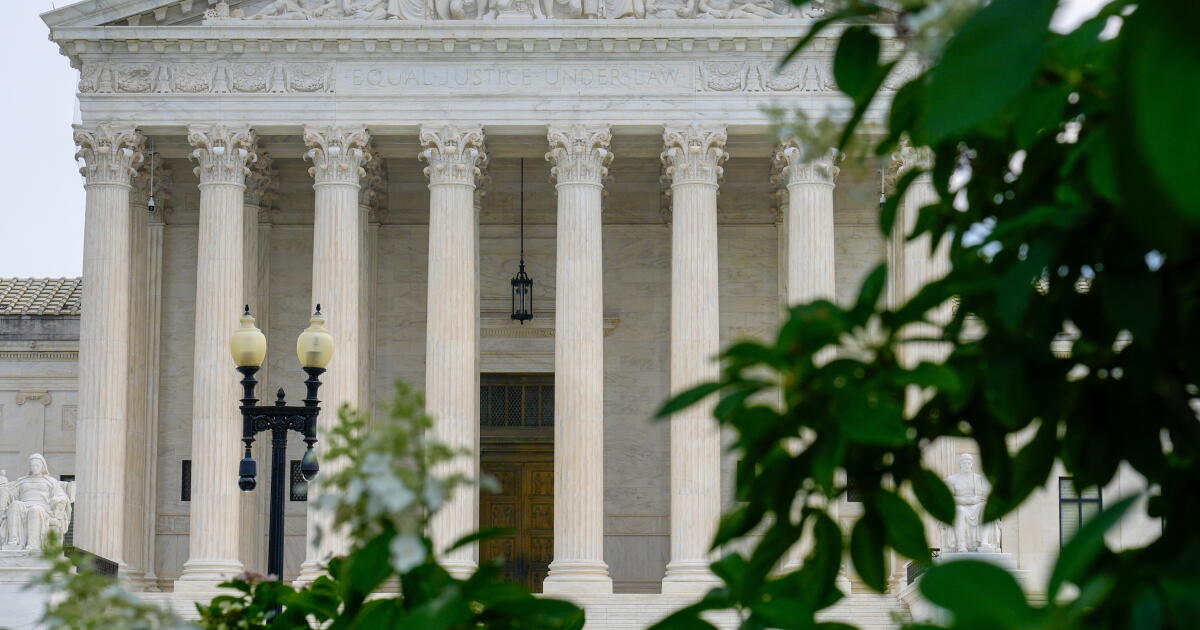
WASHINGTON — The Supreme Court justices sounded wary Monday of state-by-state lawsuits that could impose huge damage verdicts on energy producers for the effects of global climate change.
Instead, several of them suggested these local and state claims may be blocked by the federal Clean Air Act.
“Interstate air and water pollution are matters for federal law,” said Justice Brett M. Kavanaugh. “We don’t have to reinvent the wheel. This kind of pollution is a federal matter unless Congress says otherwise.”
Justice Elena Kagan appeared to agree. State-by-state lawsuits “really get in way of how Congress decided to regulate greenhouse gases,” she said.
Justice Amy Coney Barrett questioned if states such as Colorado can use their courts to impose regulations on other states. “What if Colorado passed a law purporting to cap emissions in the other 49 states?” she asked.
At issue before the court was the question of whether cities and states may sue oil and gas producers for the damages inflicted by climate change.
California and nearly three dozen states and municipalities have filed such claims, but none have gone to trial. Meanwhile, the Republican-led states and the Trump administration opposed these lawsuits.
The eight justices struggled Monday to decide if these lawsuits are a matter for state or federal law.
Justice Samuel A. Alito, a staunch conservative, said he is sitting out the case, presumably because he owns stock in oil companies that would be affected by a ruling. Without him, the court could split 4 to 4 and be unable issue a decision.
That remains a possible outcome, but Monday’s argument kept open the prospect that a conservative majority will rule to block the climate-change suits.
Last year, the Colorado Supreme Court ruled that Boulder County may sue for damages in a local court. In a 5-2 ruling, the state judges said Boulder could sue and seek damages by alleging the oil producers are a “public nuisance.”
In February, the justices agreed to hear an appeal from the oil industry backed by the Trump administration. Its lawyers argued that the Constitution and federal law do not allow for such claims to be resolved in local courts.
Chief Justice John G. Roberts sounded skeptical of opening the door to a wave of climate change lawsuits.
“If you prevail, the next day a municipality in every single state will file a lawsuit. How do you think that will work out on the ground?” he asked the lawyer representing Boulder.
For much of the two-hour argument, the justices struggled over whether federal law imposes a limit on such lawsuits, or instead whether states and their judges are free to seek damages for the harm they have suffered.
They did not signal a clear outcome. They could decide to stand aside and allow the suits to proceed in state courts.
“If Boulder’s claims are allowed to go forward, some 90,000 municipalities across the country will have the ability to make national and international energy policy by asking juries to impose catastrophic damages on selected fossil-fuel producers,” Kannon Shanmugam, a lawyer for the oil and gas companies, told the court.
Attorney Kevin Russell, representing Boulder, agreed Congress could adopt limits on such state lawsuits, but it has not done so. He said the court should not invent new limits to benefit one powerful industry.
So far, judges across the nation have been divided. Some have ruled that federal law preempts or blocks states and counties from suing under state law.
Justice Clarence Thomas has often voted against claims that a federal law or policy “preempted” or blocked states from pursuing their separate rules or policies.
Some legal experts doubted the oil industry would prevail in this case without both Thomas and Alito. But the defection of one conservative could lead to a tie vote.
If the court splits evenly and cannot rule, it would be a major disappointment for the oil industry because it would allow all the climate-change suits to proceed, at least for now.