***Subsidy restoration, demonstrates ignorance on governance, economy —Tinubu
***Atiku unveils new subsidy model, to ‘target, cap, budget, track every barrel’
By Johnbosco Agbakwuru & Omeiza Ajayi
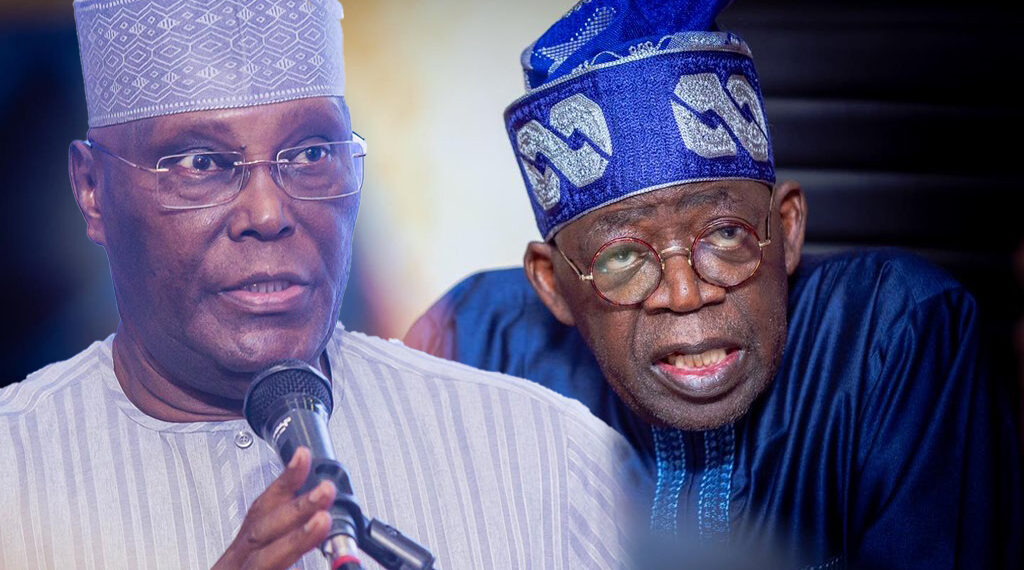
ABUJA — President Bola Tinubu, and former Vice President and presidential candidate of the African Democratic Congress, ADC, Atiku Abubakar, yesterday, disagreed over the return of fuel subsidy.
While Tinubu said Atiku was demonstrating ignorance about governance and the economy in his call, Atiku who unveiled a new petroleum subsidy model, proposed to replace Nigeria’s old import-subsidy system with a targeted, capped and independently audited production subsidy for domestic refineries.
While receiving Governor Ademola Adeleke of Osun State at the Presidential Villa, Abuja, yesterday, Tinubu said: “Let’s look at the trajectory of history. I saw one of my opponents now say he will go back to subsidy. I read it. That is a demonstration of serious ignorance about governance and the economy.
Before I came here, 27 states were unable to pay salaries, not to even talk of pensioners. In your state, I know a man that I raised who is nicknamed ‘half salary.’
“They come to the Federal Government cap in hand, unable to do anything.”
The President said ordinary people and their families now feel the impact of government through the provision of infrastructure: good road networks, housing, school rehabilitation, hospital and healthcare resuscitation, and the training of teachers and health workers to protect vulnerable families.
“It’s part of your responsibility. And the people of fortunate states pronounce their judgment on you: that they love you. They want you to govern.
“So, you’re going back to govern. Anybody, any democrat, anybody in the political environment who cannot celebrate the joy of a free and fair election does not deserve the laughter and the happiness of democracy. Don’t make a single individual a victim of your campaign.”
President Tinubu advised the governor to build a network of unity and unified tools, and everything required for governance. “Like I said, you did not conquer anybody.
“You won the election. That is the essence of democracy. I’m so happy that we had this talk. All for the reconciliation, expand your coast. That is the only way you can give thanks to our people. Not the way you sang it or celebrated it.
“It’s the way you act it. Use me as an example. I got here. God put me here. Where you are today, God put you there. Not the smartness of any of these people.
“It’s just their support, not their smartness. It’s the wish of God that prevailed and the wish of the people for you. And you are in a very unique position to make history, promote unity, peace, and stability.
“Use it. It started as a progressive. All you are doing now is progressive instinct. And you did a very good mobilisation with your team. Very good job. You saw fear. You screamed. Promote democracy. Promote stability. Promote the rule of law. Don’t stigmatise any of your opponents,” Tinubu told the governor.
Speaking to journalists, the Osun State governor said: “I’m here to thank Mr. President, the father of the nation, because he fought for this democracy.
“That is why he allowed a free and fair election, and that is the result. That is why I’m here — to say thank you and to ensure that democracy lives in Nigeria.”
Atiku unveils new subsidy model
Atiku, in a statement by his Senior Special Assistant on Public Communication, Phrank Shaibu, said the Economic Recovery Plan AERP 2027 would shift subsidy support away from fuel importation towards local refining.
He argued that the real choice facing Nigeria is not between subsidy and no subsidy, but between an opaque system that breeds waste and a disciplined one that delivers measurable benefits.
“We will move subsidy from importation to production, from middlemen to Nigerian refineries, and from unverifiable claims to verifiable barrels. The principle is simple: the subsidy will follow the barrel,” he said.
Under the plan, qualifying refineries would get domestic crude at a preferential price, but only in exchange for verified production and guaranteed local supply.
According to him, every subsidised barrel would be tracked from allocation through refining to delivery, with crude intake, yields and inventories reconciled to rule out the kind of phantom cargoes and unverifiable claims that plagued the old regime.
He said operators who divert products, falsify records or fail to pass on the benefit to consumers would lose eligibility, refund the subsidy and face prosecution.
The former vice president added that allocation itself would be rules-based and open to both public and private refineries, to prevent the programme from becoming a vehicle for enriching politically connected operators.
Central to the proposal, he said was fiscal discipline, adding that the subsidy would run within a fixed annual ceiling approved by the National Assembly, with independent auditors verifying output against spending.
He described it as a deliberate break from a subsidy regime that has historically produced open-ended, unbudgeted liabilities.
“Support per barrel would also shrink over time as local refining capacity grows, built around a statutory sunset clause. Our objective is not permanent subsidy. It is to use temporary and disciplined support to build a refining industry strong enough eventually not to need subsidy,” he said.
Atiku also renewed his attack on the President Bola Tinubu administration’s handling of subsidy removal, questioning what exactly disappeared when the president declared “subsidy is gone” at his inauguration in May 2023, given that NNPC Limited’s audited accounts still recorded roughly N4.84 trillion in “Energy Security Expenses” in 2023 and N7.13 trillion in 2024.
“You cannot abolish subsidy at Eagle Square and allow subsidy-like costs to resurface in government accounts without explaining the contradiction. Nigerians cannot pay for subsidy removal twice through punishing pump prices and through unexplained subsidy-like costs against their commonwealth.
“Tinubu’s approach was: announce first, impose the pain immediately, and explain the accounts later. Ours will be: define the intervention, establish the ceiling, appropriate the money, track the crude, verify the production, guarantee the consumer benefit, publish the accounts and progressively reduce the subsidy,” he said.
Atiku is a hypocrite, renegade —Presidency
However, the Presidency also took a swipe at Atiku Abubakar’s promise to restore petrol subsidies if elected President in 2027.
The Presidency in a statement by Special Adviser to the President on Information and Strategy, Bayo Onanuga, said: “Against expectations that he would announce a more creative and ingenious alternative to the programme being executed by the Tinubu administration, Atiku Abubakar behaved like a man from an archaic past who least comprehends the present economic dynamics and suggested that he would restore the much-abused, wasteful, pillaged, corruption-ridden fuel subsidy regime, which the Petroleum Industry Act made illegal from the end of June, 2023.
“Even though he used to believe that the subsidy regime must be eliminated, a point he canvassed in the run-up to his defeat in the 2023 election, he has now opportunistically recanted the major plank of his economic doctrine and turned a renegade.
“It is not difficult to explain why Atiku has latched onto the abandoned subsidy regime, five months to the election. Desperate for power, he needed to make a promise that he knew, if he were candid with our people, does not make fiscal sense, is retrogressive, and is against the genuine interest of the people.
“But before his suggestion hoodwinks the people, we must quickly subject the promise to a serious examination, especially in the context of Nigeria’s present economic and petroleum realities.
“First, we must clear some ambiguities about the so-called subsidy. It is not some money sitting in the treasury to be disbursed to offer cheap fuel to Nigerians. It is the massive discount the NNPC offered the Nigerian government: selling fuel it bought at N100 at N50 at the pump, leading to under-recovery of costs and massive losses.
“Somewhere in the NNPC books are still trillions of Naira in subsidy costs that the Nigerian government has not paid. Contrary to Atiku’s claim in his interview, no N30 trillion subsidy windfall or savings exists anywhere except in his imagination.
“Restoring the old arrangement, therefore, cannot simply be presented as a matter of announcing that government will once again pay part of the cost of petrol.
“It would require a clear legal, fiscal and administrative framework, including identifying the source of the funds and determining how such a policy would be implemented under the present petroleum-market structure.
“Nigeria cannot afford to return to policies whose costs are hidden from citizens until they appear later as debt, reduced government spending on social services, and further pressure on the national currency.
“The country should welcome robust debate about the cost of living and the direction of economic policy. But that debate must be anchored in Nigeria’s reality today, not yesterday’s petroleum economy,” he added.