The United Nations Development Programme (UNDP) has signed a new agreement with the Stellar Development Foundation to expand the agency’s use of blockchain-based payments after completing pilot projects in five countries, signaling a broader role for public blockchain infrastructure in its development programs.
The agreement follows 16 months of research and pilot programs in Haiti, Syria, Kenya, Guatemala and The Gambia, with additional projects in Colombia and Papua New Guinea, the agency said Monday. According to UNDP, the next phase will establish the process for country offices to use blockchain payments across a wider range of programs.
UNDP said the pilots produced measurable results. In Syria, a Cash for Work program that recorded payments onchain reduced distribution costs from 10% to 2%, while a pilot in Haiti continued processing payments during a cellular network outage.
Blockchain payment networks, particularly those supporting stablecoins, have increasingly been promoted as a way to improve cross-border payments and remittances, especially in regions where access to traditional banking services is limited. The announcement marks one of the clearest examples of a UN agency moving beyond limited blockchain trials toward broader use of the technology for humanitarian purposes.
Source: UNDP
Last month, UNDP launched a Blockchain Advisory Group at the Proof of Talk conference in Paris, France, to help guide its use of blockchain technology across development programs. Beyond digital payments, the group will explore how blockchain can support digital public infrastructure and improve public systems.
Related: Kbank teams with Ripple on overseas blockchain remittance trial
Stablecoins gain ground in remittance markets
UNDP’s expanded use of blockchain payments reflects a broader push to modernize cross-border payments in emerging markets, where limited access to traditional banking and high remittance costs have made stablecoins an increasingly attractive alternative.
Ripple recently acquired an equity stake in African fintech Flutterwave as part of a broader effort to expand the use of its RLUSD stablecoin and the XRP Ledger across Africa, where remittances remain a major source of household income.
Latin America is also emerging as a key market for stablecoin-powered remittances, with issuers targeting payment corridors in Argentina, Bolivia, Colombia and Venezuela.
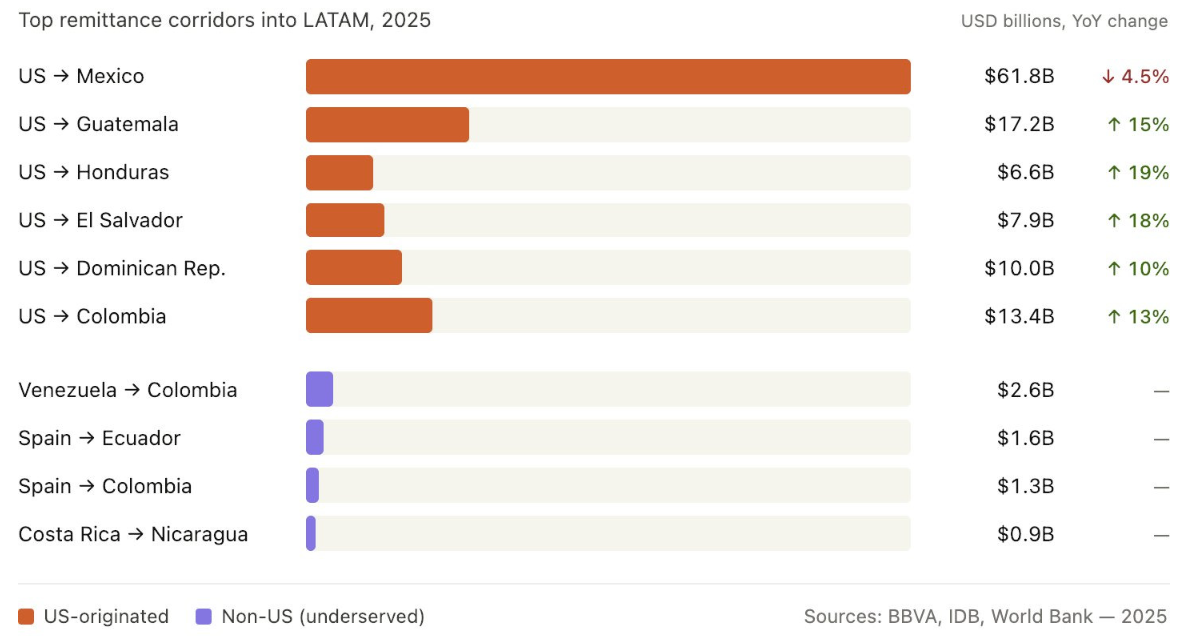
The most active remittance channels across Latin America. Source: Claudia Wang
Former UN under-secretary-general Vera Songwe said the growing importance of digital payments extends beyond remittances. Speaking at the World Economic Forum’s annual meeting in January, Songwe said that stablecoins are becoming “more important than aid” in some developing economies because they provide access to digital financial services where traditional banking remains out of reach.
“650 million people don’t have access to a bank account in Africa,” Songwe told the WEF attendees. “With a smartphone, you have access to stablecoins, so you can save in a currency that is not exposed to fluctuations of inflation and making you poor.”
Related: Bybit Pay enters South Africa through MoneyBadger integration