For companies operating in the Middle East, the difference between a covered loss and an uninsured one may come down to a single word: war.
Many businesses in the region bought insurance that protects against terrorism or sabotage. Far fewer purchased coverage explicitly designed to cover “war.” The difference between terrorism and war can be the difference between a paid claim and a denied one.
As missile strikes, drone attacks and maritime disruptions linked to Iran ripple across the region, insurers and policyholders are scrutinizing how those distinctions hold up in practice.
Most large companies rely on standard property insurance as a base layer of protection. Those policies almost universally exclude war, often defined broadly to include not just declared conflicts between states, but also hostilities, invasions, civil war, rebellion, insurrection and actions taken by sovereign powers.
Coverage for those risks must be bought separately, typically through political violence or political risk policies. Even then, many companies purchase only partial protection.
Full political violence insurance can cover property damage and business interruption tied to terrorism, sabotage, riots, strikes, civil commotion, insurrection, rebellion, mutiny, coup and war. But according to global insurance broker Marsh, the majority of companies operating in the Middle East opted only for terrorism and sabotage coverage, stopping short of war.
Complacent
Experts say companies just got complacent.
“Many companies that have operated in the Middle East for a long time have become accustomed to the relative stability in the region and may have under-appreciated how quickly geopolitical risk can escalate,” said David Kinzel, Aon’s U.S. Practice Leader for Political Risk told CNBC.
22 ships were attacked in the Strait of Hormuz since the start of the conflict until mid-April, according to Al-Jazeera citing ship tracking data from Kpler.
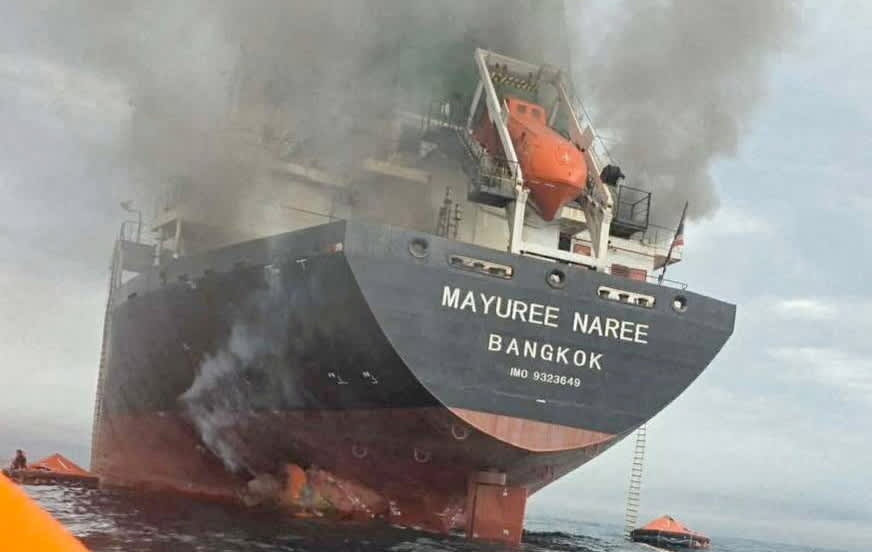
Other commercial vessels have suffered direct hits or near misses, with fires, hull damage and cargo losses reported following missile attacks. War risk insurers dramatically raised premiums for transits through the region, while many shipping companies rerouted vessels around Africa instead of using the Suez Canal, adding weeks and millions of dollars in fuel costs per voyage.
On land, brokers report strikes landing near — and in some cases on — data centers and manufacturing facilities, complicating claims under both property and cyber policies.
‘Hostilities’
President Donald Trump has repeatedly avoided labeling the conflict with Iran a “war,” a distinction with legal and political ramifications.
In remarks and formal notifications to Congress this month, the president referred instead to “hostilities,” writing that “the hostilities that began on February 28 have terminated,” and arguing that the absence of a declared war meant congressional authorization was not required.
Politically, the language may help the administration manage its obligations under the War Powers Resolution. From an insurance standpoint, however, market participants say it carries far less weight.
“From our perspective regarding marine insurance, ‘war’ speaks to perils more so than a declaration,” Baxter Southern, head of Marine for Howden U.S. told CNBC.
What matters is not political rhetoric, but policy wording.
Insurers rely on the facts of a specific loss and whether that loss meets the definition of war embedded in the policy and whether the insurer can prove it.
Cyber grey area
That burden of proof is especially high in cyber insurance.
Nearly every cyber policy includes some form of war exclusion, but those clauses vary widely. Many also contain carve-backs that preserve coverage for cyber terrorism — attacks carried out to advance financial, ideological, religious or political objectives — even when war-related language is present.
Insurers looking to deny a claim because of war exclusions, typically must demonstrate that an attack was carried out by a sovereign government or under its direction or control. But Iran (and Russia, China, and North Korea, as well) rely heavily on proxies and loosely affiliated groups, making cyber “warfare” hard to prove.
Insurers and brokers say cyber war exclusions have attracted enormous attention but have rarely, if ever, been fully applied in claims tied to state-linked attacks, including during the Russia-Ukraine conflict.
That does not mean insurers would not attempt to apply them, but it does mean disputes are more likely to center on proof and attribution than on how the White House describes the conflict.
In marine insurance, war risk is more explicitly built into coverage structures.
Standard hull policies typically include a “Free of Capture and Seizure” clause that excludes losses tied to warlike operations, hostilities, detention and confiscation, regardless of whether war is formally declared. Companies that want protection for those risks must buy separate war risk coverage.
Even there, limits apply. Most war risk policies contain a so-called “Five Powers War Exclusion” that eliminates coverage entirely if war breaks out between the United States, the United Kingdom, France, Russia or China.
Put simply, even insurance designed to cover war has a line it will not cross.
Litigation ahead
So far, industry sources say litigation tied specifically to the definition of war has not yet surged in relation to the Iran hostilities, but legal experts predict it will.
Meanwhile, some insurers have largely paused or restricted new coverage for parts of the Middle East. Others are tightening terms or carving out countries as they try to reduce their own exposure. Coverage remains available, but it is more expensive, more conditional and subject to rapid change.
Behind the scenes, brokers say the bigger lesson is emerging clearly.
Many companies failed to fully understand the risk and appear to have underinsured for it.
For years, some businesses treated parts of the region as stable enough to forgo broader war coverage. That decision may have looked reasonable during a long stretch of relative calm. It looks very different once missiles landed in the UAE, Oman and other nations perceived as safe and stable.
As insurers begin parsing claims and policy language, companies are learning that in insurance, definitions are not academic, they’re financial.