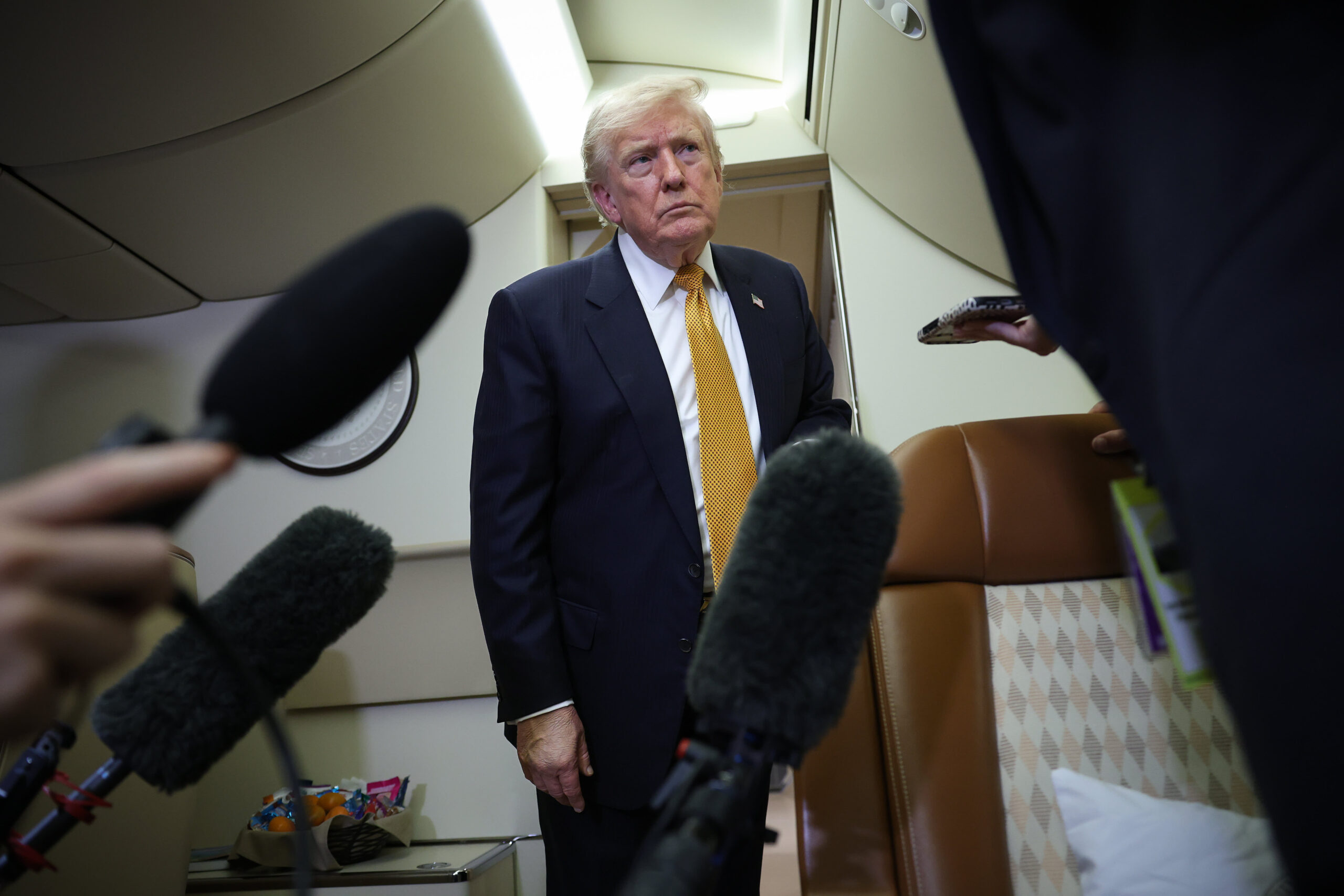

U.S. President Donald Trump said Wednesday evening that he does not know whether Washington and Iran are returning to a full-fledged war, but told reporters that Iran “badly” wants to make a deal to cease escalating hostilities in the Middle East.
Trump flew back to Washington, D.C., via the U.K. on Wednesday. Speaking to reporters on board Air Force One as he departed the U.K.’s Mildenhall Air Force Base, the president said American forces had “just hit [Iran] very hard.”
“I say we hit them 20 to 1 – every time they hit us, we’re going to hit them 20, and we did it last night,” he said. “They did a little something today, but it was really retribution for last night … when they hit, we hit back much harder.”
When asked whether the U.S. and Iran are returning to a full-scale military conflict, Trump responded: “I don’t know,” before adding that if the war resumed the U.S. would “win it very quickly.”
“We have many ways we can win, but we’ve already won militarily,” he said. “They have very little left, and they want to make a deal so badly. They called a little while ago. They want to make a deal so badly. I just don’t know if they’re worthy of making a deal. I don’t know that they’re going to honor the deal. That’s the problem.”
CNBC has reached out to the Iranian government for a response to Trump’s comments.
Is the ceasefire ‘over’?
U.S. Central Command said its forces had carried out another round of strikes on Wednesday, in a bid to “degrade Iran’s ability to attack commercial shipping and innocent civilian mariners in the Strait of Hormuz.”
The strait, a waterway in the Middle East that’s a critical shipping route for oil and other vital commodities, has been a point of contention in negotiations to end the U.S.-Iran war. A blockade of the Strait of Hormuz throughout most of the conflict has led to a surge in energy costs that fueled concerns about higher inflation and central banks taking a hawkish turn.
On Tuesday, the U.S. military conducted a round of offensive strikes against Iran in retaliation for three commercial vessels transiting the Strait of Hormuz coming under attack. The U.S. Treasury Department subsequently withdrew a waiver that had allowed Iran to sell its oil.
The two operations saw U.S. forces hit approximately 170 Iranian military targets, according to Centcom.
Last month, Washington and Tehran confirmed they had agreed on a memorandum of understanding to bring the war to an end. But at the NATO summit in Ankara, Turkey, on Wednesday morning, Trump raised questions about the status of the fragile ceasefire between the two sides.
“I think it’s over,” Trump said in response to a reporter’s question about the deal during an appearance with NATO chief Mark Rutte.
“I don’t want to deal with them anymore … as far as I’m concerned, it’s over,” he said of the Iranian government.
Trump said that Washington’s delegation wanted to negotiate a peace deal, but that he saw it as “a waste of time dealing with” the Iranian side.
In a statement on Thursday, Iran’s Foreign Ministry said the U.S. strikes were a violation of the memorandum of understanding reached less than four weeks ago.
The Ministry of Foreign Affairs “emphasizes the determination of the Islamic Republic of Iran to defend the national sovereignty and territorial integrity of Iran and punish the aggressors,” the statement said.
Oil prices were marginally higher on Thursday morning, with global benchmark Brent crude futures for September delivery holding above the $78 mark while U.S. West Texas Intermediate crude futures traded at $73.55.