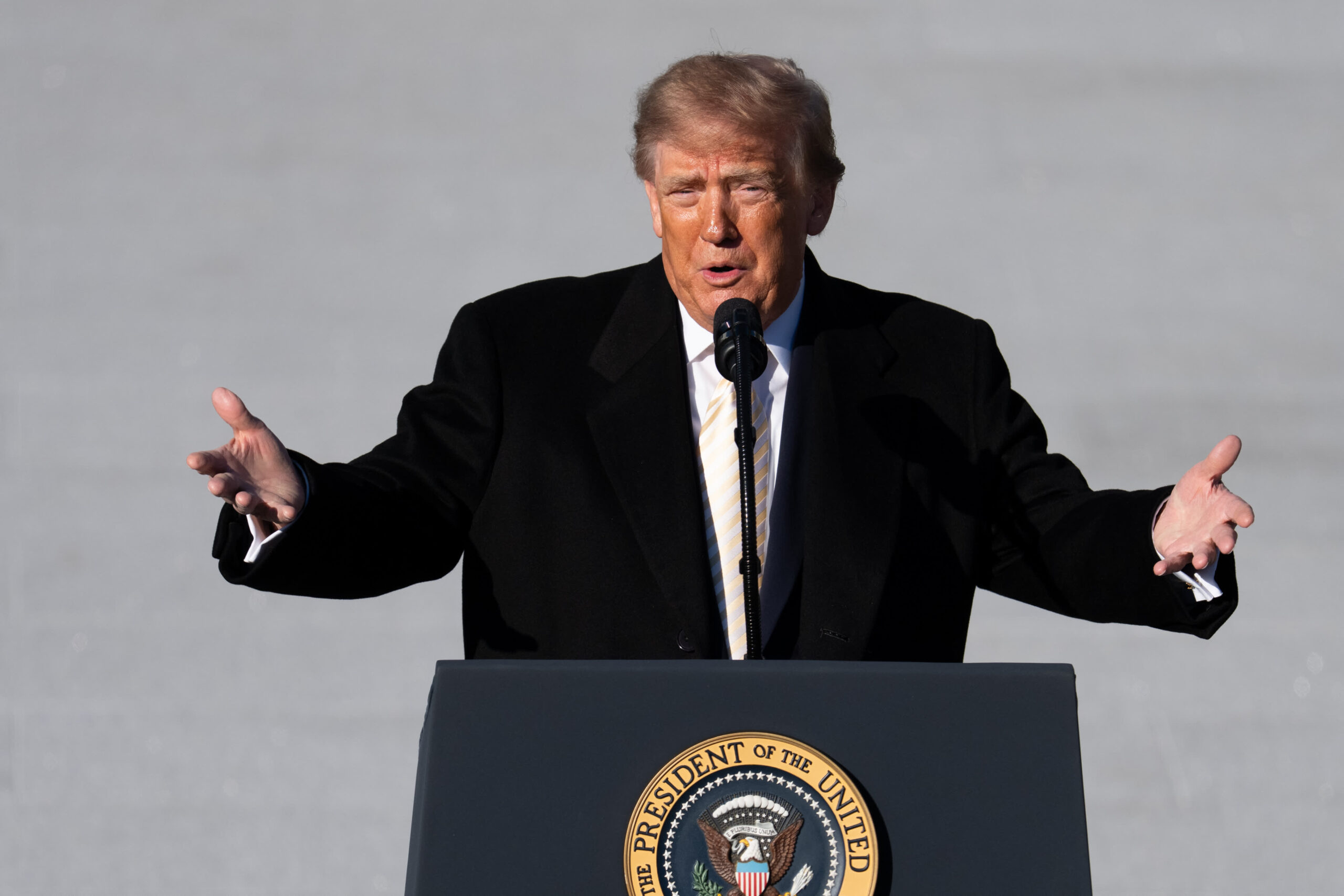
President Donald Trump on Thursday falsely deemed the latest gross domestic product revision a mistake, claiming that it should be “immediately investigated.”
Data released Wednesday from the Commerce Department revealed that the U.S. economy exhibited much stronger growth for the third quarter than initially estimated, showing that real GDP grew at a 4.3% annualized rate. That was revised upward from the department’s advance estimate of 3.4%.
That revision was a “RECORD SETTING ERROR,” Trump said in a Truth Social post, suggesting that the initial release could have influenced the outcome of the 2026 U.S. midterm elections, where Democrats flipped both chambers of Congress and even multiple governorships.
“I would like to wish a Happy Thanksgiving to even those who issued fake Economic Numbers, just prior to the Election, and corrected them yesterday, three weeks late, showing that the GDP was actually 4.3%, versus 3.4%, A RECORD SETTING ERROR, and one so grave that it should be immediately investigated,” Trump wrote.
However, the difference between the advance estimate and the figure in the second release is far from being an all-time record. It was the largest revision since the 1.2 percentage point revision seen in the second quarter of 2020.
On an absolute basis, the latest revision was tied for 16th among all revisions from the advance estimate to the second release since 1990. It also tied four other quarters with a similar 0.9 percentage point difference — and was approximately double the average revision of 0.43 percentage points for all 147 quarters.
The upward revision shows Trump’s policies are “delivering results” that defy expectations, White House spokesman Matthew Middleton told CNBC.
Nothing new
Revisions to U.S. economic numbers are not necessarily out of the ordinary. Initial reports count on partial survey data and early estimates. Those data are later updated with more survey responses — which sometimes leads to changes from the initial reports.
GDP data is revised repeatedly over a five year period. By the time the final revision is done, the average absolute error from the second release to the final is 1.14 percentage points.
The advance estimate for Q3 U.S. GDP, which came just days before Election Day in early November, was still better than the figure economists had expected at the time. It also showed a significant step-up in growth from the second quarter.
Because that was a strong showing for the economy, some on Wall Street consider this week’s revision to be a confirmation of the economy’s recent growth trend.
Jim Baird of Plante Moran Financial Advisors said immediately following the release that it “reinforces an increasingly familiar tension” that the economy is “performing quite well, but its resilience also gives the Fed an even stronger case for further rate hikes.”
“The economy isn’t merely hanging in there. It continues to demonstrate considerable resilience, with consumers spending, businesses investing and few signs that restrictive monetary policy is creating significant cracks in the broader expansion,” the firm’s chief investment officer said.
Traders are currently pricing in a nearly 100% chance of a hike at the Federal Open Market Committee’s December meeting, per the CME FedWatch tool. They’re also anticipating an additional hike in January.
— CNBC’s Jeff Cox and Fred Imbert contributed reporting