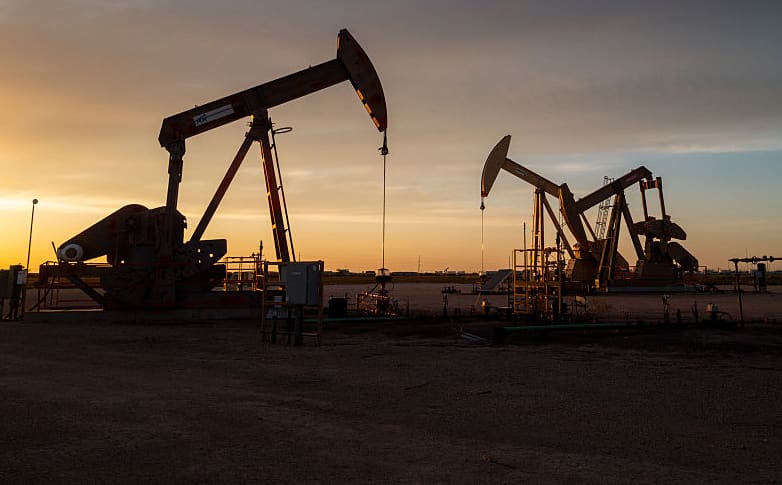
Oil prices turned lower Monday after Iran said negotiations with the U.S. could be pursued based on Tehran’s interests, raising investors’ hopes that diplomacy could end the sharp escalation in fighting.
Brent crude futures, the international benchmark, were last seen trading 9 cents lower at $88.01 per barrel. U.S. West Texas Intermediate crude fell 25 cents to $82.24 per barrel.
Iran’s Foreign Ministry spokesman Esmail Baghaei told reporters at a press conference that intermediaries had continued to exchange messages with Tehran during the latest round of U.S. strikes.
Brent prices jumped nearly 4% overnight to break $90 per barrel, after the U.S. confirmed at least three service members have died during the recent fighting.
The U.S. has bombed Iran for nine consecutive nights in retaliation for repeated attacks on oil tankers transiting the Strait of Hormuz. Tehran is trying to force ships to transit the strait through its territorial waters. Its attacks have killed at least two seafarers and injured more than a dozen this month.
A vessel off Oman’s coast was struck by a projectile Sunday causing a fire onboard, according to an incident report from the United Kingdom Maritime Trade Operations Centre. The crew safely abandoned the vessel and were retrieved by a tug boat, UKMTO said.
Iran has responded to U.S. strikes by firing missiles at Washington’s Middle East allies. Tehran attacked a power and desalination plant in Kuwait over the weekend for the second time in two days, the Kuwait Times reported. Kuwait is heavily dependent on such plants for drinking water.
Tehran’s Houthi allies in Yemen, meanwhile, declared a maritime embargo against Saudi Arabia on Monday. The embargo could exacerbate the oil supply disruption triggered by Iran’s tanker attacks in Hormuz. The Houthis have repeatedly threatened to close the Bab el-Mandeb Strait, which connects the Red Sea to global markets.
The Saudis have diverted millions of barrels of oil per day through a pipeline to an export terminal on the Red Sea. Those exports have acted as a crucial relief valve for the global crude market during the U.S.-Iran war.
Gasoline prices rose back to $4 per gallon Monday as U.S. crude oil has surged 18% this month, according to AAA. Prices at the pump were last at that level on June 17, when the U.S. and Iran signed an interim agreement intended to reopen the strait and stop the fighting.
Amrita Sen, founder and director of research at Energy Aspects, said a substantial slowdown in shipping traffic through the Strait of Hormuz and depleted global inventories could push oil prices to more than $100 per barrel.
“The market is still quite complacent despite the price increase we have seen,” Sen told CNBC’s “Access Middle East” on Monday.