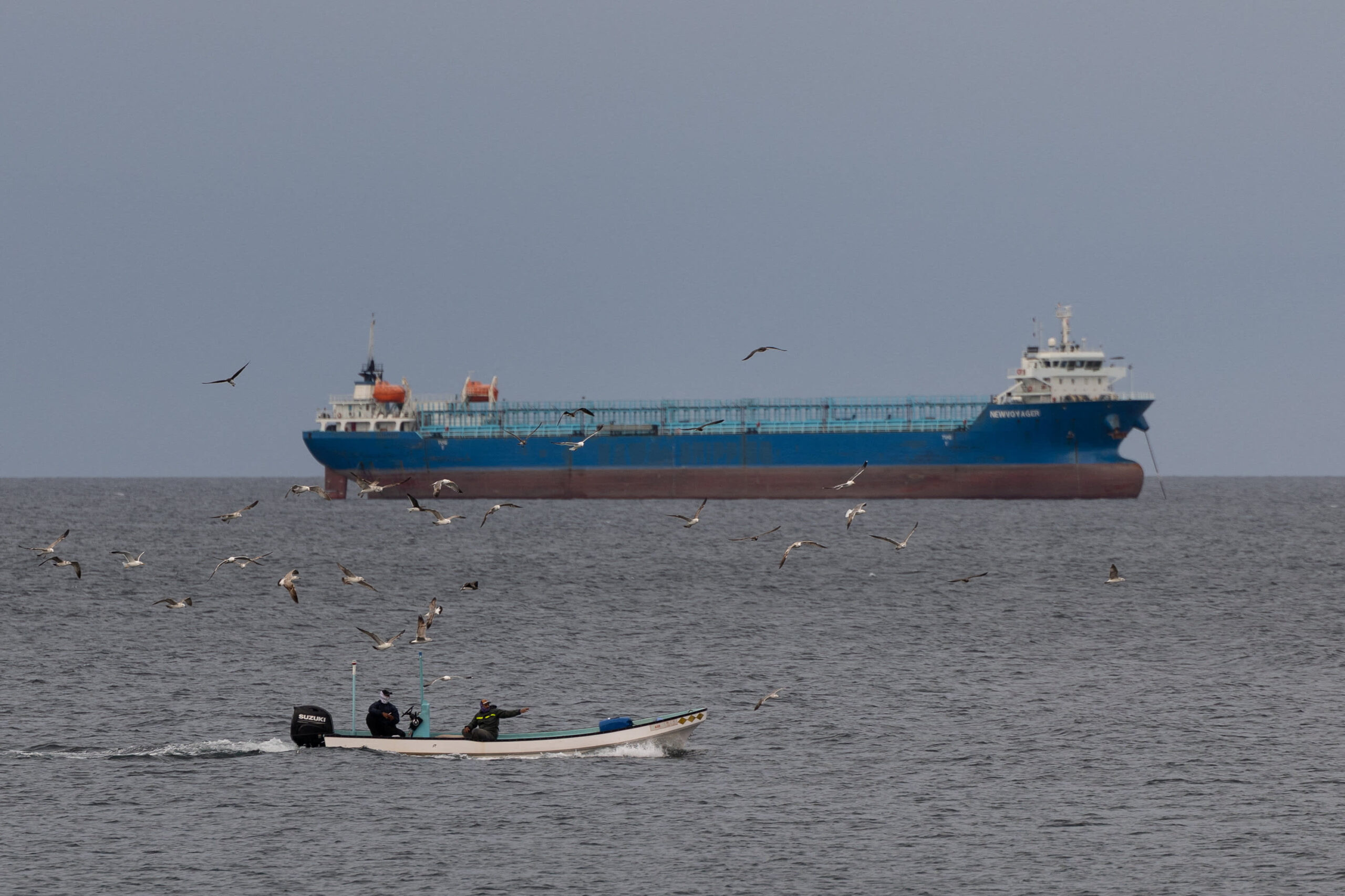
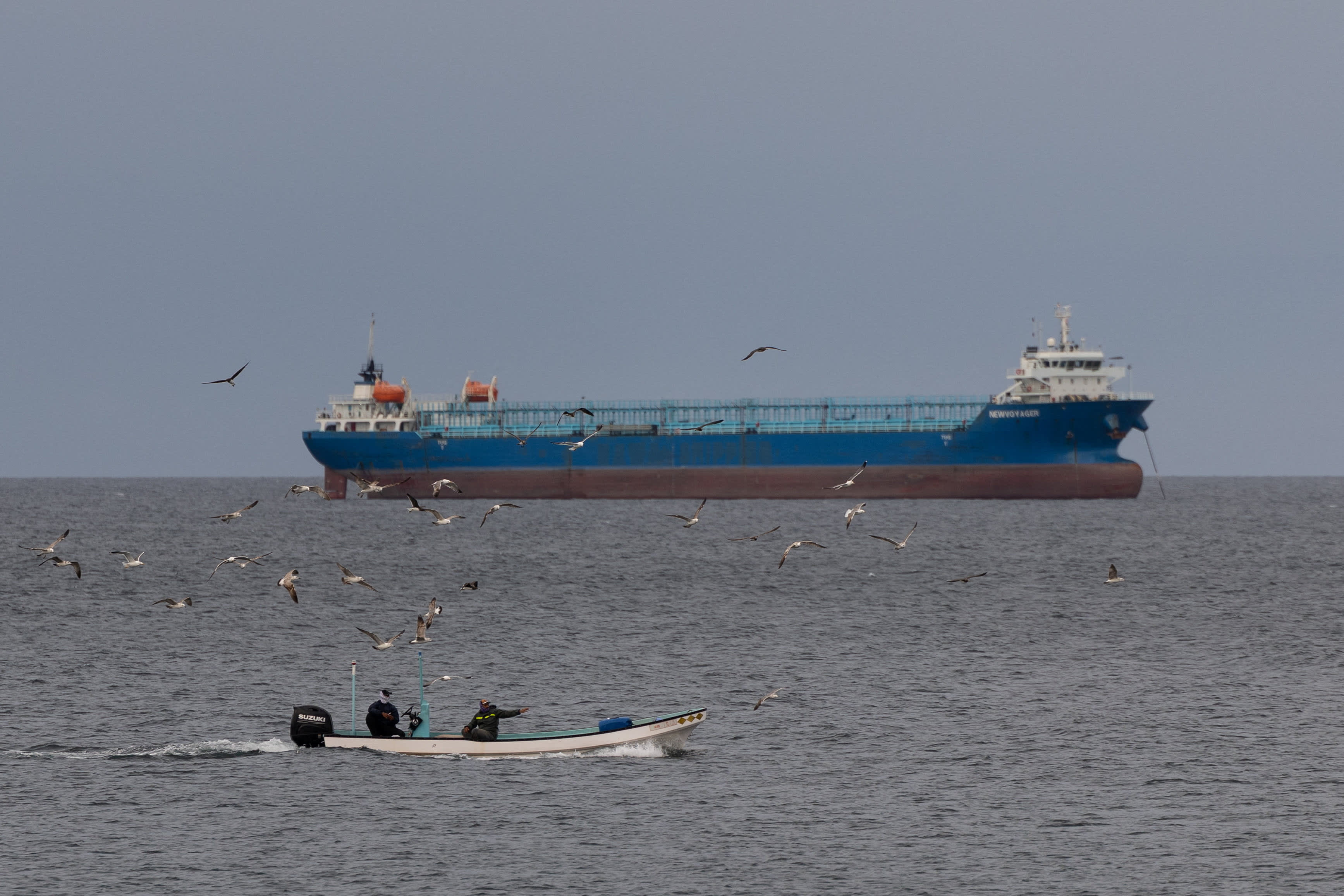
Iran said Saturday that it has reimposed the closure of the Strait of Hormuz less than a day after reopening it to shipping traffic, but President Donald Trump warned that Tehran could not blackmail the U.S. by shutting the waterway.
The strait is closed until the U.S. blockade is lifted, Iran’s Revolutionary Guard navy said, warning that “no vessel should make any movement from its anchorage in the Persian Gulf and the Sea of Oman, and approaching the Strait of Hormuz will be considered as cooperation with the enemy” and be targeted.
Two gunboats from the Revolutionary Guard opened fire on a tanker transiting the strait, the British military’s United Kingdom Maritime Trade Operations center said. It reported the tanker and crew as safe, without identifying the vessel or its destination. Shipping sources told Reuters at least two other vessels reported coming under fire while trying to transit the waterway.
In Mumbai, India summoned Iran’s ambassador after an Indian-flagged vessel carrying crude oil was attacked while trying to cross the strait, Reuters reported.
The closing of the waterway comes after Iran declared on Friday that the strait is open to commercial ships during a ceasefire between Israel and Lebanon, but confusion quickly emerged about whether the sea lane was really open without conditions.
Iranian state media said on Saturday that the strait was closed due to the U.S. failing to hold up its end of the bargain. Iran blamed the U.S. for its ongoing blockade of Iranian ports.
“Iran agreed to allow a limited number of ships to pass through the Strait of Hormuz according to agreements,” the Islamic Republic of Iran Broadcasting (IRIB) service said in a post on X.
“But U.S. did not fulfill their obligations. So, the Strait of Hormuz is now closed again and passage requires IRAN approval,” IRIB said.
Iranian state media also aired a statement from Revolutionary Guard spokesperson Lieutenant Colonel Ebrahim Zolfaghari detailing the reimposition of vessel restrictions on the strait, MS Now reported.
Zolfaghari said that “control of the Strait of Hormuz has returned to its previous state … under strict management and control of the armed forces.” He warned that Iran would continue to block transit through the strait as long as a U.S. blockade of Iranian ports remained in effect.
Trump says Iran ‘got a little cute’
In Washington, Trump said U.S. talks with Iran are going well and that he expects to have more information “by the end of the day.”
Trump made the comments during a White House event where he signed an executive order directing the Food and Drug Administration to expedite the review of certain psychedelic drugs designed as breakthrough therapy for mental illness.
Trump declined to take reporters’ questions about Iran but said, “We have very good conversations going on.”
He said Iran “got a little cute,” later adding, “They wanted to close up the strait again,” referring to the Strait of Hormuz.
“They can’t blackmail us,” Trump said.
Trump said on Friday that he would likely not extend the two-week ceasefire, which is due to end on Wednesday. U.S. and Israeli forces began an aerial campaign against Iranian targets on Feb. 28. Trump agreed to the ceasefire on April 7 in exchange for Iran completely opening the strait.
“Maybe I won’t extend it, but the blockade is going to remain. But maybe I won’t extend it, so you have a blockade, and unfortunately, we’ll have to start dropping bombs again,” Trump said.
Peace talks in the Pakistani capital, Islamabad, between a U.S. delegation led by Vice President JD Vance and Iranian negotiators headed by parliamentary speaker Mohammad Bagher Ghalibaf failed to reach an agreement last weekend.
Iran reviewing new proposals put forward by U.S.
Iran’s Supreme National Security Council said in a statement that Pakistan’s army chief, serving as an intermediary, presented the proposals to Iran during his recent visit to Tehran, and that they were still under review.
It was not revealed what was in the proposals.
The council said Iran has yet to respond, but further talks would require the U.S. to abandon “excessive demands and adjust its requests to the realities on the ground.”
It also said that Iran will maintain full control over traffic through the Strait of Hormuz until “the war fully ends and lasting peace is achieved in the region,” adding that it would collect detailed information on passing vessels, issue transit certificates and impose tolls.
The council added that it considered the U.S. naval blockade a violation of the ceasefire and that the Strait of Hormuz would not reopen until it was lifted.
Confusion over Hormuz
Iranian Foreign Minister Seyed Abbas Araghchi on Friday said on social media: “In line with the ceasefire in Lebanon, the passage for all commercial vessels through Strait of Hormuz is declared completely open for the remaining period of ceasefire.”
However, vessels must transit through a “coordinated route” announced by Iran’s maritime authorities, Araghchi said. It is unclear whether Tehran will force ships to pay a toll to pass the strait.
Israel and Lebanon agreed Thursday to a 10-day ceasefire starting at 5 p.m. ET that evening. Israel’s military campaign in Lebanon against the militant group Hezbollah, which is a close ally of Iran, has been another hurdle in negotiations between Washington and Tehran.
But the confusion over the strait’s status has left ship operators in a state of limbo.
Video footage from ship-tracking firm Kpler showed that several tankers and cargo ships attempted to exit the waterway on Friday but turned back.
“They’ve clearly not been given approval to pass through,” Matt Smith, director of commodity research at Kpler, told CNBC.
Oil prices plunged more than 10% on Friday to below $90 per barrel. About a fifth of the world’s crude supplies passed through the strait before the war. The closure of the sea lane connecting the Persian Gulf to global energy markets has triggered the largest oil supply disruption in history.
Another major sticking point in the negotiations has been the issue of recovering material from Iran’s nuclear program. Trump told reporters on Air Force One that the U.S. will “go in with Iran and we will take it together, and we will bring it back, 100% of it back to the United States.”
“We’ll take it after the agreement is signed,” he said.
Iran says it won’t hand over enriched uranium to U.S.
Trump on Friday said that Iran had agreed to hand over its stockpile of enriched uranium, but Iranian Deputy Foreign Minister Saeed Khatibzadeh dismissed the U.S. president’s claims and sounded a note of caution regarding future talks between the two countries.
Speaking to the Associated Press in the Turkish city of Antalya, Khatibzadeh said the Iranians were not ready for a new round of face-to-face talks with the U.S. because the Americans “have not abandoned their maximalist position.”
On Friday, Trump said the U.S. will go into Iran and “get all the nuclear dust,” referring to the 970 pounds (440 kilograms) of enriched uranium believed to be buried under nuclear sites badly damaged by U.S. military strikes last year.
French peacekeeper killed in Lebanon
French President Emmanuel Macron said a French soldier was killed and three others were wounded Saturday during an attack on U.N. peacekeepers in southern Lebanon. “Everything suggests that responsibility for this attack lies with Hezbollah,” Macron wrote on social media. The UNIFIL peacekeeping force also blamed Hezbollah.
Hezbollah denied involvement.
Pakistan’s foreign minister said fighting between Israel and Hezbollah had been a key sticking point in U.S.-Iran talks, and the declaration of a ceasefire in Lebanon was seen as a boost to efforts for an Iran agreement.
It was unclear to what extent Hezbollah would abide by a truce it didn’t play a role in negotiating, especially with Israeli troops still occupying a stretch of southern Lebanon.
In Beirut, displaced families began moving toward southern Lebanon and the capital’s southern suburbs despite warnings by officials not to return home until it was clear whether the ceasefire would hold.
The Iran war has killed at least 3,000 people in Iran, more than 2,290 in Lebanon, 23 in Israel and more than a dozen in Gulf Arab states. Thirteen U.S. service members have been killed.
Pope Leo says ‘not in my interest at all’ to debate Trump
Pope Leo XIV said that it was “not in my interest at all” to debate Trump about the Iran war, but that he would continue preaching the Gospel message of peace.
Leo spoke to reporters aboard the papal plane flying from Cameroon to Angola.
He addressed the spiraling back-and-forth saga of Trump’s critiques of his peace message, which have dominated news headlines this week. But the American pope also sought to set the record straight, insisting that his preaching isn’t directed at Trump, but reflects the broader Gospel message of peace.
“There’s been a certain narrative that has not been accurate in all of its aspects, but because of the political situation created when, on the first day of the trip, the president of the United States made some comments about myself,” he said.
— The Associated Press and Reuters contributed to this report.