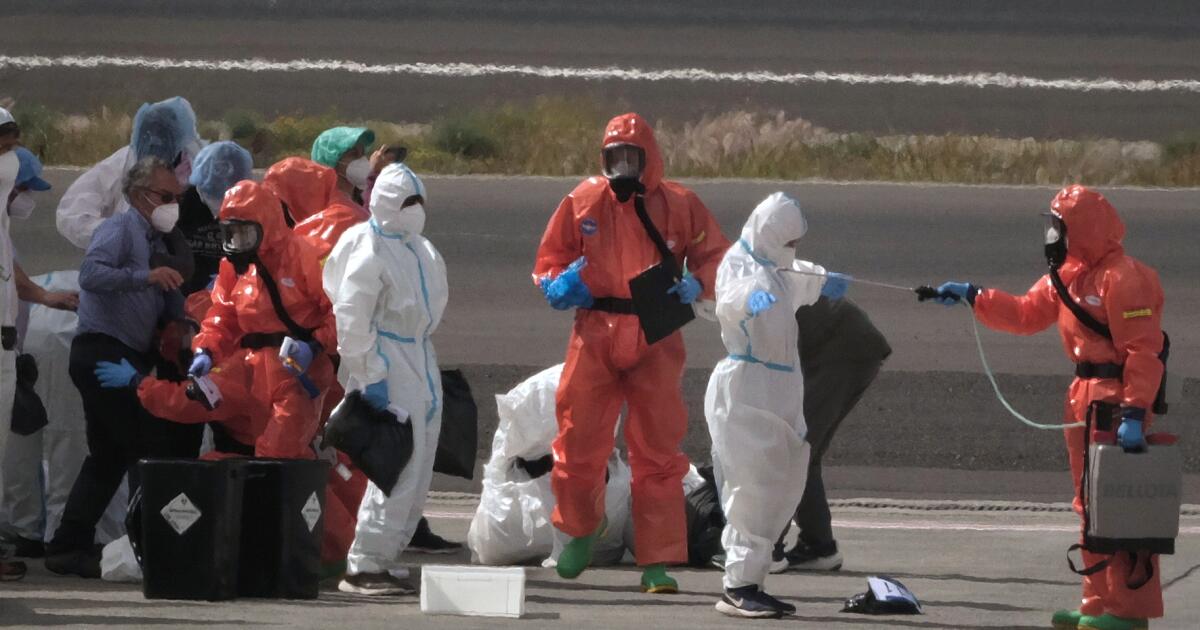

The voyage was marketed for explorers eager to venture to “the edges of the map,” from Antarctica to some of the most remote islands in the world.
It would be a tantalizing trip for tourists with an appetite for adventure — less about trips to the spa and lounging by the pool than a chance to see landscapes few humans have ever laid eyes upon.
But this call of the wild was ultimately among the factors that turned the MV Hondius into the epicenter of the first-ever deadly outbreak of hantavirus aboard a modern cruise ship. Eleven cases have been linked to the outbreak so far. Three people are dead, and two others are in intensive care.
The incident — with a few uncomfortable echoes of the onset of the COVID-19 pandemic — has sparked concerns and questions. Chief among them: Was this a freak occurrence, or a sign of things to come?
“I think it’s both,” said Dr. Peter Chin-Hong, an infectious-diseases expert at UC San Francisco.
Hantavirus had previously been an obscure illness. Typically spread through exposure to infected rodents’ urine and droppings, it’s notoriously difficult to diagnose and has no specified antiviral treatment. It was definitively identified relatively recently, in a field rodent near the Hantan River in South Korea in 1978, and it finally explained the mystery cause of the “Korean hemorrhagic fever” that infected thousands of United Nations troops during the Korean War.
Though rare, the disease has drawn attention in the U.S. over the decades due to its incredibly high case-fatality rate: up to 50% among the strains that circulate in the Americas.
Western Hemisphere hantavirus strains are so deadly because they can attack the lungs and make them leak. The strains that circulate in Asia and Europe — where hantavirus is more common, and generally less deadly — attack the kidneys.
Those who are severely ill can be treated only by putting them on life-support machines that directly add oxygen to their blood.
Despite its severity, the overall impact of the disease in the Americas has remained muted for two main reasons. First, most strains of hantavirus do not spread directly from person to person. And second, many people will not come into contact with rodents carrying the virus during their daily lives.
Excursions that attract people like those aboard the MV Hondius, however, blur the second line. Launched in 2019, the ice-strengthened vessel offered passengers opportunities for “maximum contact with the nature and wildlife you traveled so far to see,” according to its operator, Oceanwide Expeditions.
“The broader pattern is definitely not random,” Chin-Hong said, “which is more expedition tourism visiting remote areas.” Climate change, he added, is also increasing the range of certain infectious diseases.
“The hantavirus in the cruise ship is unprecedented, and reflects kind of like a perfect storm of the expedition cruise through a remote area, environmental exposure potentially during a short excursion, and the hantavirus — this particular Andes virus — being capable of going from person to person,” he said.
The Andes virus, which circulates in Argentina and Chile and is mainly spread among the long-tailed pygmy rice rat, is the only hantavirus strain known to be able to transmit from human to human.
Such inter-person spread occurred previously in a deadly outbreak in Argentina. From November 2018 through February 2019, the Andes virus infected 34 people there, killing 11, according to a study in the New England Journal of Medicine.
There were 149 passengers and staff aboard the MV Hondius when the ship publicly disclosed that three of its passengers had died. Of the 18 U.S. citizens on the ship, one passenger initially tested positive for hantavirus overseas but also got a negative test result; a follow-up test is now being done in the U.S., and results are expected in a day or so, Dr. David Fitter, incident manager for the Centers for Disease Control and Prevention’s hantavirus response, told reporters in a briefing Wednesday.
That patient, who is not ill, is being monitored at a biocontainment unit at the University of Nebraska Medical Center.
Five California residents have been potentially exposed to the virus — four aboard the cruise ship, and the fifth while on a plane with an infected person in South Africa. All five are asymptomatic and appear healthy, the California Department of Public Health said Wednesday.
Most infected people actually don’t seem to spread the Andes virus, Chin-Hong said. But some do end up being “superspreaders,” infecting others at exceptional rates.
That’s what happened in 2018-19. A single person got the Andes virus from a rodent, and the outbreak was spread mainly by three sick people who attended crowded social events, the medical journal study said — including a birthday party and a wake for one of the hantavirus victims.
In the case of the MV Hondius, the first person believed to have contracted the hantavirus was a man from the Netherlands who was possibly exposed to rodents while bird-watching before boarding the ship before it left for its transatlantic journey, according to authorities. He had spent the prior three months traveling through Argentina, Chile and Uruguay, the World Health Organization said. The man boarded the ship on April 1, developed symptoms on April 6 and died on board on April 11.
“At present, the thought is that it was an ornithologist who was visiting a dump, where many rare birds congregate, and was exposed to a rodent that was in the garbage dump,” said Dr. Elizabeth Hudson, regional physician chief of infectious diseases for Kaiser Permanente Southern California.
From there, she said, the realities of cruising at sea set the stage.
“Cruise ships are a perfect environment for the spread of infectious diseases, unfortunately,” Hudson said. “You have a population of people who are living together in a relatively small and confined space, with most folks spending a good part of their time indoors eating and socializing. This means that if there’s an infection that can spread easily from person to person, the very nature of the cruise ship allows this to happen more readily.”
It can also be difficult to isolate sick people aboard a cruise ship. The MV Hondius’ doctor fell ill with hantavirus, as did another crew member who was working as a guide. Among the symptoms people reported were gastrointestinal illness, fever, general malaise, pneumonia, fatigue, aches and respiratory symptoms.
Extensive spread of the hantavirus outbreak is not expected, health experts say. Unlike COVID-19, the Andes virus is much harder to transmit from person to person.
In past outbreaks of the Andes virus, taking steps such as isolating people who are sick — and asking those who aren’t sick but have been exposed to stay away from others — have brought outbreaks to an end.
It can take up to six weeks from the time a person has been exposed to the virus to the onset of illness. That “takes us to the 21st of June,” WHO Director-General Tedros Adhanom Ghebreyesus said at a news briefing Tuesday. “WHO’s recommendation is that they should be monitored actively at a specified quarantine facility or at home for 42 days from the last exposure.”
One Californian who was on the MV Hondius, but left the ship before the hantavirus outbreak was discovered, is back home in Santa Clara County and remains healthy. That person is being asked to limit trips outside the home during the 42-day period to see if they become ill, according to Dr. Erica Pan, director of the California Department of Public Health.
Another Californian, from Sacramento County, is also back at home after sitting within a couple of seats of a hantavirus-infected passenger who was briefly on a flight from South Africa to the Netherlands before being asked to deplane because of her illness. The Californian remains healthy, but is also being asked to limit activities with others.
“They’re not to share a bed with someone else. … They shouldn’t attend social events, and they should not visit any crowded venues,” Pan said.
Two other Californians who were on board the MV Hondius are healthy and are being observed at the University of Nebraska Medical Center’s National Quarantine Unit, the only federally funded quarantine unit in the U.S. Thirteen others are also being observed there, while two are at Emory University in Atlanta.
The California Department of Public Health said it didn’t know when the Californians in Nebraska would return home.
California health officials Wednesday said that there was a fifth state resident who was potentially exposed to the hantavirus. That person left the cruise ship, returned briefly to California, then left for additional travel, all before the outbreak was announced.
That person, who remains healthy, is now in the remote Pitcairn Islands in the south Pacific Ocean — halfway between Peru and New Zealand.
Despite concerns surrounding this latest outbreak, the Andes virus is considered a poor candidate to become the next pandemic. One thing that makes COVID spread so easily is that people can infect others even if they’re not personally experiencing symptoms.
With COVID, people could get sick just by breathing in aerosolized viral particles floating around and pushed across an entire room by an air conditioning vent.
With the Andes virus, by contrast, people probably need to be symptomatic to spread illness.
The 2018-19 Andes virus outbreak in Argentina also showed that close contact is needed for transmission, including “being seated very close” to the sick person, Chin-Hong said.
Those at highest risk of getting hantavirus from another human have “some direct exposure to bodily fluids,” Pan said.
The first U.S. case of Andes virus actually occurred in January 2018, in a woman who had stayed in cabins and youth hostels in the Andes region of Argentina and Chile. She did not infect anyone else after her return despite taking two commercial flights in the U.S. while sick and before she was hospitalized in Delaware. She eventually recovered at home.
More morbidly, health experts note, the Andes virus is also too deadly for it to spread rapidly in a pandemic situation.
So why are we seeing this outbreak now?
Hantavirus appears to be expanding its range in Argentina. A report published in December noted that hantavirus in that country was moving southward.
“This redistribution indicates either ecological shifts affecting rodent reservoir populations, increased human encroachment into previously untouched habitats, or improved surveillance detecting cases in areas with lower historical awareness,” said the report, published by the Biothreats Emergence, Analysis and Communications Network, or BEACON, based at Boston University’s Center on Emerging Infectious Diseases.
From mid-June through early November, there were 23 confirmed cases in the country, with nine deaths. No human-to-human transmission was reported during that time period.
Another report suggested that changing temperatures and rainfall also affected hantavirus transmission in Argentina.
Another well-documented example of that phenomenon is the rise of dengue viruses in Argentina, which are spread by mosquitoes. Rising temperatures are making the climate more suitable for transmission, one study suggested.
“Climate change has definitely had an impact on Argentina,” Chin-Hong said. “As it gets warmer, you potentially have more rats.”