BEIRUT — When Israeli President Isaac Herzog announces his choice for who can try to form a governing coalition on Sunday, he’ll be making a pivotal decision in a contested election that many see as Israel’s most fateful.
Before Herzog are two bitter rivals: Longtime incumbent Prime Minister Benjamin Netanyahu and his right-wing Likud party versus Gadi Eisenkot, who leads the center-right Yashar party and once served as Netanyahu’s military chief of staff.
As of Thursday, after days of consultations between Herzog and the parties that won a place in the 120-seat Knesset, Eisenkot appears to have the advantage. When no party prevails in the parliament, the president — an otherwise largely ceremonial figure — selects which party can lead in forming a government.
In last month’s election, Eisenkot’s opposition bloc, which includes several parties, gained 48 seats, and picked up 19 more after Arab-led parties said they will support him, for a total of 67. The Arab-led parties, which gained a record number of seats after unprecedented voter turnout by Palestinians with Israeli citizenship, are now in the unlikely position of kingmakers.
Netanyahu and his right-wing allies garnered 46 seats, Herzog said. United Torah Judaism, a party focusing on ultra-Orthodox Jews that wants to maintain a military service exemption for religious students, has traditionally supported Netanyahu, but has so far refused to support either candidate.
Until a coalition is formed, Netanyahu, who has served 19 years over three tenures as prime minister, remains the head of a caretaker government. If neither candidate succeeds in forming a government, another election must be held.
Eisenkot’s numbers make clear that he should take the first stab at forming a government, Herzog said, but it was “not entirely clear” that Eisenkot will succeed given what Herzog called “the mutual vetoes between the blocs and within the blocs themselves.”

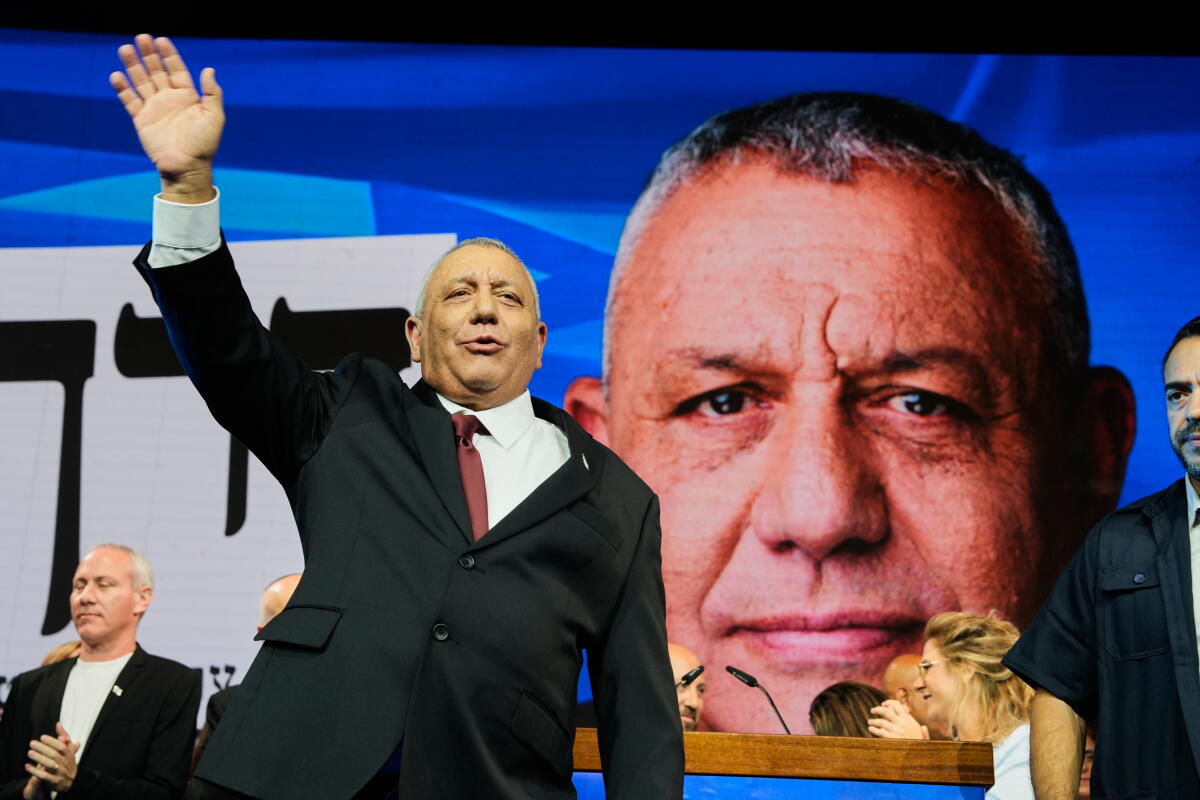
Gadi Eisenkot, leader of the Yashar party, waves to supporters following the release of the first exit poll results in Israel’s general election in Tel Aviv on Oct. 28.
(Baz Ratner / Associated Press)
Eisenkot must rely in large part on a fragile and contentious grouping of parties that have yet to prove they would be willing to work together beyond toppling Netanyahu.
Key to negotiations will be the Arab-led parties, including the Joint List, a three-party alliance with 11 seats. The Joint List rejects Zionist parties that define Israel as a Jewish state. It also calls for the establishment of a Palestinian state in the West Bank and Gaza with East Jerusalem as its capital.
There’s also Raam, an Islamist group that takes a more practical view of Israeli politics, with eight seats. In 2021 Raam joined an Israeli governing coalition, making it the first independent Arab party to do so.
The Joint List does not plan to become part of any incoming administration. Instead, the main objective, according to Joint List head Yousef Jabareen, is clear: “We will do everything to remove the greatest threat to all of us,” he wrote on X on Thursday, “which is the continuation of the rule of Netanyahu.”
But Jabareen added that the Joint List would demand the government stop race-baiting and demonizing the country’s Arab population. The alliance will also call for increased investment, a more concerted fight against organized crime in Arab-dominated areas, and “an end to the occupation and the wars and a choice of life and peace.”
“Because the two peoples who live here deserve to live with dignity, equality, and peace,” Jabareen wrote in his post.
Even without joining the government, by assisting Eisenkot’s bloc to take power, Arab-led parties would have some leverage to steer policy, said Diana Buttu, a lawyer and former legal advisor to the Palestine Liberation Organization.
“They’re saying, ‘We will push from behind, but our pushing is not cost-free.’ It’s not holding on to a ministry, sure. But it’s having a say in matters that impact our society,” Buttu said. “They will try to have a say over who the ministers are, what laws get passed and don’t get passed, and on matters that impact the Palestinian community in general but equality more broadly.”
Raam, meanwhile, has said it would be willing to join an anti-Netanyahu administration. But any Arab-led party participation would be at odds with other members of Eisenkot’s coalition, many of whom view Palestinian citizens of Israel as fifth columnists and a threat to national security.
“Eisenkot won’t be able to form a government with all those parties,” said Dahlia Scheindlin, an Israeli political analyst and pollster, adding that at least three parties in Eisenkot’s four-party bloc have conveyed that they would not want to be in a government with Arab parties.
The most vociferous opposition has come from Avigdor Lieberman, head of the right-wing secular Yisrael Beiteinu party.
“Lieberman is completely against it, and he’s put a boycott on building a government with any Arab parties,” Scheindlin said, adding that Lieberman has shown flexibility on the issue of conscription in an attempt to bring ultra-Orthodox parties into the fold.

Supporters of Prime Minister Benjamin Netanyahu protest outside Yashar party leader Gadi Eisenkot’s residence against the formation of a Jewish-Arab government on Nov. 1.
(David Goldman / Associated Press)
Eisenkot, meanwhile, has sought to stabilize his coalition by imposing conditions he hopes will mollify his Jewish Israeli partners.
In a statement on X on Friday, he emphasized that Israel is “in the midst of a dangerous political tsunami” and that he would form a “national emergency government” with parties that agree to what he called “four foundational principles”: Recognizing Israel as a Jewish and democratic state, accepting the values of Israel’s declaration of independence, mandatory military service for all and recognition of Hamas as a terrorist organization that must be dismantled.
Both Arab-led parties have condemned Hamas’ Oct. 7, 2023, attacks and the killing of civilians, but have declined to label the Palestinian militant faction a terrorist group, saying such a move would serve as justification for Israel’s no-holds-barred assault on Gaza.
Nevertheless, Arab-led parties have insisted they will not let Eisenkot’s conditions be obstacles to supporting him, Scheindlin said. Raam’s head, she added, has indicated he can compromise, while the Joint List believes the conditions don’t apply to them since they will not be part of the government.
“They don’t have to agree to those things to support from the outside,” she said.
The electoral horse-trading comes at a delicate time for Israel. The U.S. midterms showed a marked collapse in support for Israel in both Democratic and Republican circles, and Netanyahu’s government now faces a full-on reassessment of its relationship with its top ally.
On the line is not only U.S. military assistance, but also the diplomatic shield Netanyahu has relied on to press his attacks in the West Bank, Lebanon and Syria with little regard to international opprobrium.
Earlier this week, President Trump made a surprise announcement, saying he would cut the roughly $4 billion Israel receives in annual aid by the end of the year, ahead of the agreement’s expiration in 2028.
That move has added further fuel to opponents of Netanyahu, who, in addition to being the target of an international arrest warrant and an investigation into corruption charges, now faces arguably the most consequential fight of his storied political career.
Though Netanyahu’s coalition lost its majority in the Knesset, his Likud Party got the most seats of any individual party — a demonstration of how the controversial 77-year-old leader retains larger-than-expected support among many Israeli voters.
But his adversaries, pointing to the U.S. midterms, insist that his brand has become toxic for Israel, and that a change must happen.
“Whoever tries to obstruct and torpedo the formation of the government for personal and non-substantive reasons will be remembered in history as one who did not rise to the magnitude of the moment and did not act to save Israel in its time of emergency,” Eisenkot said. “This will not be forgiven.”


