As news spread Saturday of President Donald Trump‘s removal of Venezuelan President Nicolas Maduro, a split screen emerged in Congress: Republicans largely celebrated the military operation, while Democrats condemned the president’s actions and questioned their legality.
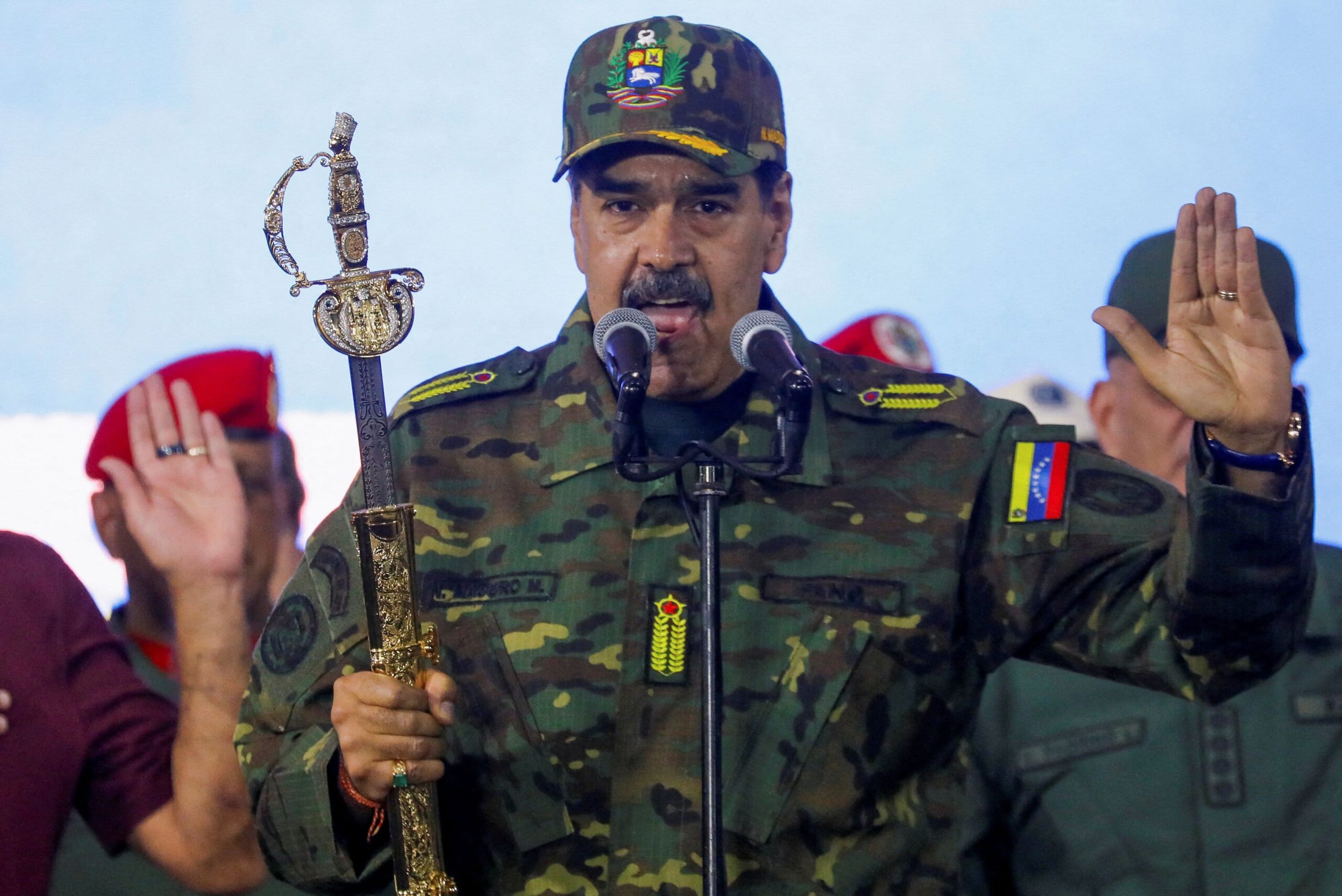
After months of pressure on Maduro, Trump announced on Truth Social that the U.S. had assisted in a “large scale strike” against the country and its leader, who was captured along with his wife, Cilia Flores, and is being brought to the U.S.
“Trump rejected our Constitutionally required approval process for armed conflict because the Administration knows the American people overwhelmingly reject risks pulling our nation into another war,” Sen. Andy Kim, D-N.J., said in a post to X on Saturday.
The Constitution grants Congress primary authority to declare war. The War Powers Resolution, passed in 1973 in response to the Vietnam War, limits the president’s ability to take military action unilaterally and requires the president to consult with Congress when troops are deployed.
But lawmakers said the president did not seek approval and did not brief Congress on his plans.
Trump is expected to meet with House Republicans on Tuesday at the Kennedy Center, MS NOW reported, citing two sources. Trump will reportedly make an appearance at the gathering and it is unclear how long he will stay, MS Now reported.
The lawmakers had already been scheduled to meet at the center for a policy forum to discuss the agenda for the second half of the 119th Congress, according to an invitation obtained by MS NOW.
Senate Minority Leader Chuck Schumer, D-N.Y., in a statement, called the decision to take military action in Venezuela without congressional authorization “reckless.”
“The administration has assured me three separate times that it was not pursuing regime change or taking military action in Venezuela. Clearly, they are not being straight with Americans,” Schumer said.
Rep. Gregory Meeks, D-N.Y., the ranking member on the House Foreign Affairs Committee, told MSNOW that he had “no briefing or heads up. I received all information from the news media at this point.”
And Sen. Tom Cotton, R-Ark., who sits on the Senate Armed Services Committee, was among those who cheered the capture of Maduro, but said Congress had not been given any forewarning.
“And that’s probably one reason why it didn’t leak over these four days,” Cotton said, in an interview on “Fox & Friends” on Saturday. “Congress isn’t notified when the FBI is going to arrest a drug trafficker or cyber criminal here in the United States. Nor should Congress be notified when the executive branch is executing arrests on indicted persons.”
Attorney General Pam Bondi on Saturday said in a post on X that Maduro and his wife have been indicted in the Southern District of New York.
They have been charged with conspiracy to commit narco-terrorism, cocaine importation conspiracy, possession of weapons and destructive devices, and conspiracy to possess machineguns and destructive devices against the U.S., according to Bondi’s post.
Trump seemed to shrug off concerns about the constitutionality of the attack during a call-in to “Fox & Friends.”
“The Democrats, maybe they’ll take a shot… all they do is complain,” Trump said. “They should say, ‘great job.’ They shouldn’t say, ‘Oh gee, maybe it’s not constitutional.’ You know, the same old stuff that we’ve been hearing for years and years and years.”
The president also said that the attack originally had been planned for earlier in the week but was rescheduled due to weather. No U.S. soldiers were killed in the operation, he said.
During a press conference at Mar-a-Lago on Saturday, Secretary of State Marco Rubio said members of Congress were called immediately after the mission, which he said was “largely a law enforcement function.” Notifying members ahead of the action could have jeopardized the mission, he said.
“This was not the kind of mission that you can do congressional notification on. It was a trigger-based mission… it’s just simply not the kind of mission you can call people and say, ‘Hey, we may do this at some point in the next 15 days,” Rubio said.
“Congress has a tendency to leak. This would not be good. If they leaked… I think it would have been maybe a very different result,” Trump said at the press conference.
“Congress will leak, and we don’t want leakers,” he continued.
The Trump administration has ramped up pressure on the Venezuelan government in recent months, alleging that Maduro is the head of a narco-terror organization. He recently ordered a complete blockade on sanctioned oil tankers moving in and out of the country and has been targeting alleged Venezuelan drug boats.
House Speaker Mike Johnson, R-La., said in a statement that he had spoken “in the last several hours” with Rubio and Defense Secretary Pete Hegseth and that the White House was working to schedule briefings with members when Congress is back in session next week.
“President Trump is putting American lives first, succeeding where others have failed, and under his leadership the United States will no longer allow criminal regimes to profit from wreaking havoc and destruction on our country,” Johnson said.
Senate Majority Leader John Thune, R-S.D., called the operation an “important first step to bring [Maduro] to justice for the drug crimes for which he has been indicted in the United States.” Neither Thune nor Johnson, through their offices, responded to requests for comment on whether Republican leaders had been briefed ahead of the attack.
“I spoke to Secretary Rubio early this morning, and I look forward to receiving further briefings from the administration on this operation as part of its comprehensive counternarcotics strategy when the Senate returns to Washington next week,” Thune said.
As news of the attack on Venezuela broke early Saturday, there was at least some Republican skepticism.
“I look forward to learning what, if anything, might constitutionally justify this action in the absence of a declaration of war or authorization for the use of military force,” Sen. Mike Lee, R-Utah, posted to X.
Hours later, and after a phone call with Rubio, Lee had changed his tune.
“This action likely falls within the president’s inherent authority under Article II of the Constitution to protect U.S. personnel from an actual or imminent attack,” Lee said in a subsequent post.
Rep. Marjorie Taylor Green, R-Ga., the former Trump ally who had a falling-out with the president and is resigning from Congress on Jan. 5, was part of a small group within the GOP who questioned the attack.
“(W)hy is it ok for America to militarily invade, bomb, and arrest a foreign leader but Russia is evil for invading Ukraine and China is bad for aggression against Taiwan? Is it only ok if we do it? (I’m not endorsing Russia or China),” Greene posted to X on Saturday.
And Rep. Thomas Massie, R-Ky., a frequent foil to Trump, questioned the constitutionality of Trump’s removal of Maduro.
“If this action were constitutionally sound, the Attorney General wouldn’t be tweeting that they’ve arrested the President of a sovereign country and his wife for possessing guns in violation of a 1934 U.S. firearm law,” Massie posted to X.
Democrats, meanwhile, called for more answers and questioned what might come next for Venezuela, where Maduro has ruled for more than a decade.
“Maduro is an illegitimate ruler, but I have seen no evidence that his presidency poses a threat that would justify military action without Congressional authorization, nor have I heard a strategy for the day after and how we will prevent Venezuela from descending into chaos,” Rep. Jim Himes, D-Conn., ranking member on the House Permanent Select Committee on Intelligence, said in a statement.
“Secretary Rubio repeatedly denied to Congress that the Administration intended to force regime change in Venezuela. The Administration must immediately brief Congress on its plan to ensure stability in the region,” Himes continued.
House Minority Leader Hakeem Jeffries, D-N.Y., in a statement on Saturday, also said Trump did not properly notify Congress of the military action. He questioned how many American troops would remain on the ground and who would run Venezuela now that Maduro has been deposed.
“Pursuant to the Constitution, the framers gave Congress the sole power to declare war as the branch of government closest to the American people,” Jeffries said. “The House and Senate must be briefed immediately and compelling evidence to explain and justify this unauthorized use of military force should be presented forthwith.”