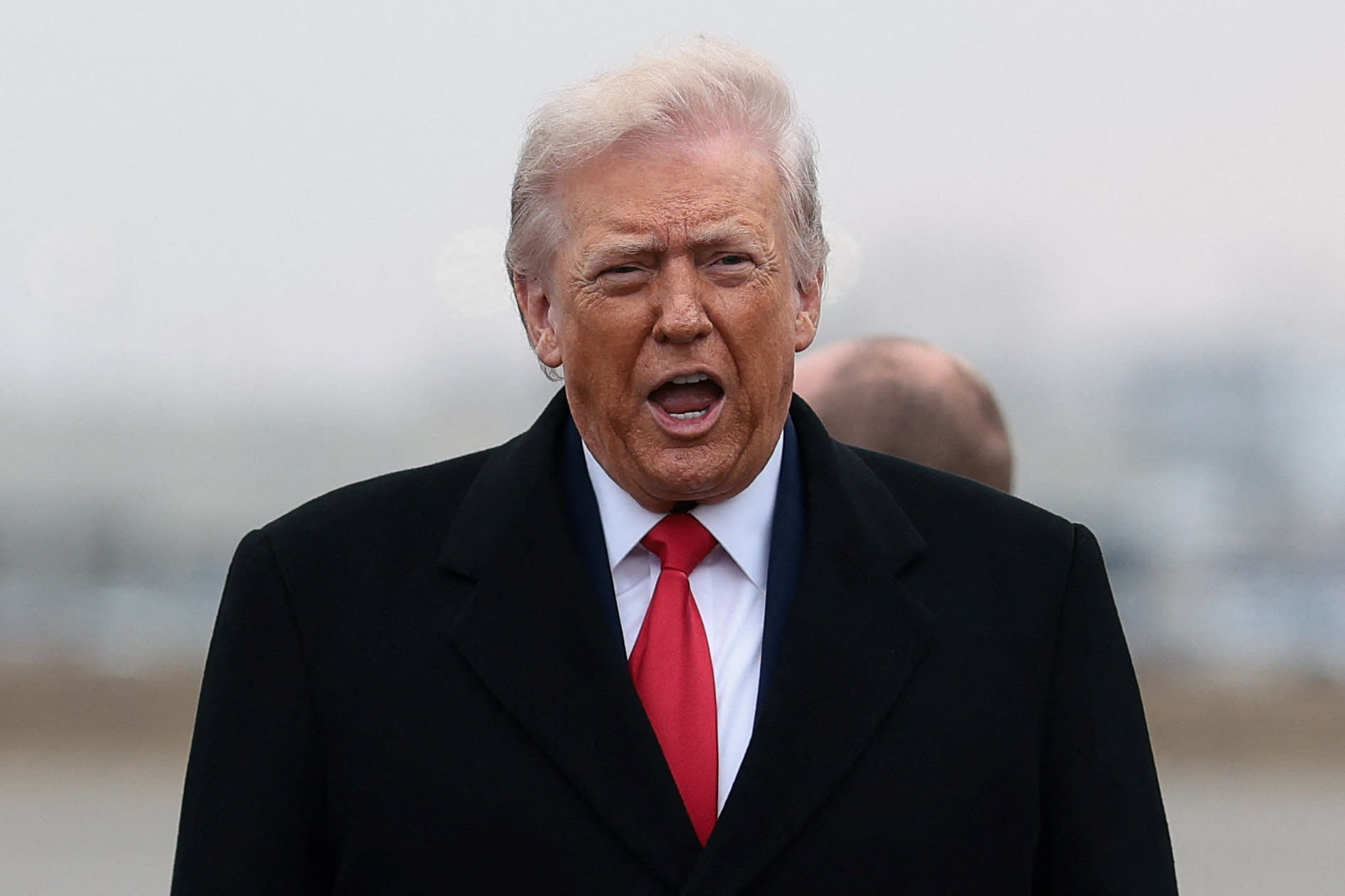
Eight NATO members’ goods sent to the U.S. will face escalating tariffs “until such time as a Deal is reached for the Complete and Total purchase of Greenland,” President Donald Trump announced Saturday.
The tariffs targeting Denmark, Norway, Sweden, France, Germany, the United Kingdom, the Netherlands and Finland will start at 10% on Feb. 1, Trump wrote in a Truth Social post.
The tariffs will shoot up to 25% on June 1, the president said.
The penalties would presumably stack on top of the existing U.S. tariffs already levied on goods from these countries.
Tariffs imposed by the U.S. on its allies already average about 15% on goods from the European Union countries in Trump’s crosshairs and roughly 10% on imports from the United Kingdom, with rates varying by sector.
In sensitive areas such as metals and certain autos, stacked measures have already pushed effective tariffs into the mid-teens to mid-20% range.
The imposition of tariffs on one or more members of the EU, which comprises 27 nations, means the new tariffs would apply to all. Trump’s demands now threaten the EU-U.S. trade agreement struck in August.
Manfred Weber, a senior member of the European Parliament (MEP), said the EU trade deal with the U.S. is “not possible at this stage.”
“The EPP is in favour of the EU-U.S. trade deal, but given Donald Trump’s threats regarding Greenland, approval is not possible at this stage,” he wrote in a post on X. “The 0% tariffs on U.S. products must be put on hold.”
Ambassadors from the EU will convene for an emergency meeting on Sunday, Reuters reported. Cyprus, which holds the six-month rotating EU presidency, called the meeting, which is set to start at 5 p.m. local time (11 a.m. ET).
Tariff strategy
Trump’s post suggested that the new tariffs on European allies are being imposed in response to the countries’ moving troops to Greenland. They took that step as the Trump administration has floated utilizing the U.S. military as part of its ramped-up efforts to acquire the Danish territory.
The eight countries “have journeyed to Greenland, for purposes unknown,” Trump wrote. “This is a very dangerous situation for the Safety, Security, and Survival of our Planet.”
A day earlier, Trump hinted that he may pursue a tariff strategy on Greenland similar to the one he used to force foreign countries to lower drug prices.
“I may do that for Greenland too. I may put a tariff on countries if they don’t go along with Greenland, because we need Greenland for national security,” he said at the White House on Friday.
While the president did not cite specific legal statutes in his Truth Social announcement for his latest moves, it appears to mirror his controversial use of the International Emergency Economic Powers Act, a law that grants the president broad powers during an “unusual and extraordinary threat.”
The Supreme Court could rule as soon as next week on whether to strike down the tariffs imposed under that law and could immediately imperil this new tranche, effectively daring the judiciary to intervene in a fresh trade war.
Scott Lincicome, a trade policy scholar at the Cato Institute, warned Saturday that the new threat exposes the fragility of relying on unilateral deals rather than binding treaties.
“Trump’s tariff announcement confirms… that his trade deals can be changed on a whim and are unlikely to constrain his daily tariff impulses,” Lincicome said in a statement. “Today’s threat underscores the empty justifications for Trump’s so-called ’emergency’ tariffs, which reveal the economic and geopolitical problems that unbounded executive power creates.”
European response
Across Europe, the targeted nations responded with condemnation, characterizing the tariffs as a hostile act against close military allies that threatens the very fabric of the trans-Atlantic partnership.
European Commission President Ursula von der Leyen, who spearheads the bloc’s trade policy, issued a sharp rebuke to the White House’s ultimatum, framing the tariffs not just as a trade dispute but as a test of Western values.
“We choose partnership and cooperation,” von der Leyen wrote in a post on Bluesky shortly after the announcement. “We choose our businesses. We choose our people.”
Likewise, Danish Prime Minister Mette Frederiksen told MS Now Saturday that Trump’s move came as a “surprise,” citing a recent “constructive meeting” with U.S. Vice President JD Vance and Secretary of State Marco Rubio.
Frederiksen pushed back on Trump’s claims regarding troop movements, stating the increased presence is strictly to “enhance security” in an Arctic region that is “no longer a low tension area,” and was done in “full transparency” with U.S. allies.
Other European leaders were equally firm. European Council President Antonio Costa said Saturday that the bloc is “coordinating a joint response” to the threat.
“The European Union will always be very firm in defending international law, wherever it may be,” Costa said at a press conference Saturday following the signing of a trade agreement between the EU and South American nations in Paraguay.
French President Emmanuel Macron also weighed in, posting on X that “no intimidation nor threat will influence us.” Macron warned that “stabilizing forces have awakened” and vowed that France would stand firm alongside its neighbors.
Swedish Prime Minister Ulf Kristersson sternly rejected Trump’s tariff threats.
“We will not allow ourselves to be blackmailed,” he wrote on X, adding that “only Denmark and Greenland decide on issues concerning Denmark and Greenland.”
EU’s foreign policy chief Kaja Kallas warned that the new tariffs play right into the hands of China and Russia.
“China and Russia must be having a field day. They are the ones who benefit from divisions among allies,” she wrote in a post on X. “If Greenland’s security is at risk, we can address this inside NATO.”
NATO strain and legal battles
Trump’s latest move puts further strain on NATO, the 32-member military alliance established after World War II. The cornerstone of the alliance is an agreement that an attack on any single member is considered an attack on them all.
European leaders have warned that any attempt by the U.S. to take Greenland by force could spell the end of NATO.
Trump’s tariff announcement could signal he is dropping the threat of military action to achieve his longtime goal of taking over the island. But it nevertheless ratchets up pressure on Denmark and the rest of Europe, which have flatly stated that Greenland is not for sale.
Some cautioned European leaders to avoid reacting hastily to Trump’s tariff threat.
“Just ignore it and wait and see,” Carsten Brzeski, global head of macro at ING Research, told Reuters. “Europe has shown that it will not accept everything, and so the tariffs are actually already a step forward compared to the threatened military invasion.”
Lawmakers push for de-escalation
As the White House ramped up pressure, a bipartisan U.S. congressional delegation in Copenhagen pushed back against Trump’s narrative.
“There are no pressing security threats to Greenland,” Sen. Chris Coons, D-Del., told reporters Saturday morning.
Coons and Sen. Lisa Murkowski, R-Alaska, led the trip to “restore a sense of trust” with Greenland, Coons said.
The two senators disputed Trump’s characterization of European troop movements as a conspiracy to block U.S. acquisition of the island, instead praising the deployments as NATO partners “stepping up,” Coons said, to secure the High North against Russian aggression.
“Seeing active training and deployments into one of the harshest, most remote places on Earth… we should take as an encouraging signal,” Coons said.
Murkowski emphasized that despite the president’s attacks, support for Denmark remains strong across party lines.
“You cannot allow this to become a partisan matter,” she said. “Support for our friends and allies… should not be.”
Likewise, Sens. Jeanne Shaheen, D-N.H., and Thom Tillis, R-N.C., both members of the Bipartisan Senate NATO Observer Group, warned that threatening tariffs on NATO would raise costs for U.S. families while benefiting adversaries like Russia and China.
In a joint statement, the lawmakers said: “Continuing down this path is bad for America, bad for American businesses and bad for America’s allies… At a time when many Americans are already concerned about the cost of living, these tariffs would raise prices for both families and businesses.”
The lawmakers said Danish and Greenlandic officials want to “partner with the United States,” urging the administration to “turn off the threats and turn on diplomacy.”
— Terri Cullen contributed to this report.
This is breaking news. Please refresh for updates.