The Supreme Court on Friday struck down a huge chunk of President Donald Trump‘s far-reaching tariff agenda, delivering a major rebuke of the president’s key economic policy.
The law that undergirds those import duties “does not authorize the President to impose tariffs,” the majority ruled 6-3 in the long-awaited decision.
The ruling is a massive loss for Trump, who has made tariffs — and his asserted power to impose them on any country at any time, without congressional input — a central feature of his second presidential term.
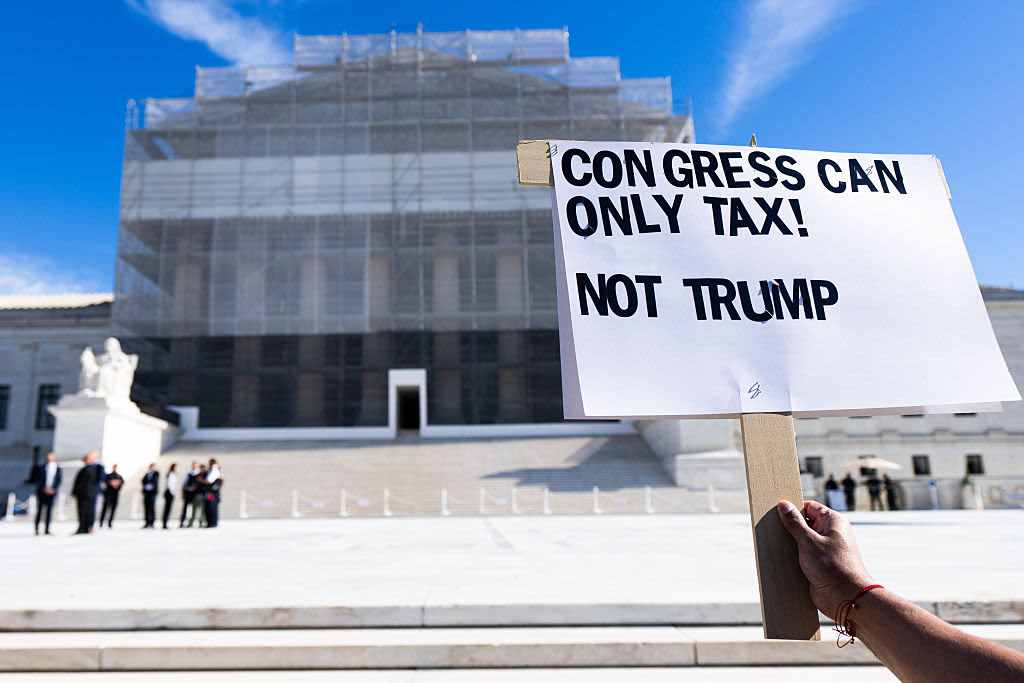
Trump’s legal stance “would represent a transformative expansion of the President’s authority over tariff policy,” the majority concluded. And they highlighted that Trump imposed the tariffs without Congress, which has the power to tax under the Constitution.
Chief Justice John Roberts delivered the opinion of the court. Justices Clarence Thomas, Samuel Alito and Brett Kavanaugh dissented.
The decision noted that before Trump, no president had ever used the statute in question “to impose any tariffs, let alone tariffs of this magnitude and scope.”
To justify the “extraordinary” tariff powers, Trump must “point to clear congressional authorization,” the court wrote. “He cannot.”
The ruling was silent on whether tariffs that have been paid under the higher rates will need to be refunded. That sum could total $175 billion, according to a new estimate from the Penn-Wharton Budget Model.
Kavanaugh wrote in his dissent that the refund process “is likely to be a ‘mess,'” after predicting that the short-term impact of the court’s tariff ruling “could be substantial.”
Betting it all on IEEPA
Since retaking the White House, Trump has rapidly reshaped America’s longstanding trade relationships by imposing a staggering array of import duties that have touched nearly every country on earth.
Many of those tariffs were invoked using a novel reading of the International Emergency Economic Powers Act, or IEEPA. They include Trump’s near-global “reciprocal” tariffs, and separate duties related to the alleged trafficking of deadly drugs into the U.S.
IEEPA does not explicitly mention tariffs, as the Supreme Court noted Friday. Instead, it allows the president to “regulate … importation” of foreign property transactions after declaring a national emergency in order to deal with certain “unusual and extraordinary” threats.
The Trump administration has argued that language empowers the president to impose tariffs on foreign goods.
Critics charged that the law does not permit the president to unilaterally impose levies of any size on any country at any time. A federal trade court and a federal appeals court both found Trump’s IEEPA tariffs illegal before the Supreme Court took up the case.
The majority of U.S. tariff revenue generated last year came from the IEEPA duties.
Trump critics — and businesses — rejoice
Reaction to the ruling quickly poured in, with the loudest voices cheering the demise of the chaotic policy that has been blamed for raising prices and straining longstanding global alliances.
“This ruling is a victory for every American family paying higher prices because of Trump’s tariff taxes,” Rep. Brendan Boyle of Pennsylvania, the House Budget Committee’s top-ranking Democrat, said in a statement. “The Supreme Court rejected Trump’s attempt to impose what amounted to a national sales tax on hardworking Americans.”
House Ways and Means Committee ranking member Richard Neal, D-Mass., in a statement called the decision “a victory for the American people, the rule of law, and our standing in the global economy.”
Footwear Distributors and Retailers of America, a U.S. sneaker industry group, said Friday’s ruling “marks an important step toward creating a more predictable and competitive environment for American businesses and consumers.”
“This ruling provides relief at a time when cost pressures have been significant,” Matt Priest, president and CEO of the footwear group, said in a statement.
The Distilled Spirits Council, an advocacy group for U.S. liquor makers, responded to the ruling by urging the Trump administration to “secure a permanent return to zero-for-zero tariffs” with top trade partners.
Doing so “would provide much needed certainty for American spirits exporters while helping ease financial pressures on bars, restaurants and retailers at a time when affordability remains a major concern for consumers,” said the council’s president and CEO, Chris Swonger, in a statement.
Dominic LeBlanc, Canada’s minister for trade with the U.S., said in an X post that the decision “reinforces Canada’s position that the IEEPA tariffs imposed by the United States are unjustified.”
Tariff tumult
Trump last April unveiled his sweeping reciprocal tariff plans at a much-ballyhooed White House event marking what he had dubbed America’s “liberation day.”
That announcement stoked a sudden market panic, and the tariffs were quickly put on pause. They have since been repeatedly tweaked, delayed and reimposed, adding confusion and further complexity to the administration’s tangled web of trade policies.
Other IEEPA-based tariffs include a set aimed at Mexico, Canada and China related to allegations that those countries have allowed the deadly drug fentanyl to flow into the U.S.
Trump, a fierce critic of America’s recent history of making free trade deals, has repeatedly praised tariffs as both a bountiful source of federal revenue and a key tool in negotiations with foreign partners and adversaries alike.
He has claimed foreign countries bear the cost of his tariffs, and he has downplayed concerns that the taxes lead to higher prices for Americans. His administration, however, has admitted that the duties are paid by U.S. importers.
Trump has claimed the tariff revenue has been so large that the duties may be able to replace the income tax. He has also floated the idea of sending Americans $2,000 tariff dividend checks.
“We have taken in, and will soon be receiving, more than 600 Billion Dollars in Tariffs,” he wrote in a recent Truth Social post.
Other estimates are significantly lower: The Bipartisan Policy Center, for instance, tallied U.S. gross tariff revenue in 2025 at about $289 billion. U.S. Customs and Border Protection said it had collected roughly $200 billion between Jan. 20 and Dec. 15.
For the IEEPA-specific tariffs, the administration said it has collected about $129 billion in revenue as of Dec. 10.
Ahead of the ruling, Trump and his administration talked up the consequences of the high court striking down the tariffs.
“If the Supreme Court rules against the United States of America on this National Security bonanza, WE’RE SCREWED!” Trump wrote on Jan. 12.
U.S. officials, including Treasury Secretary Scott Bessent, have stated they believed the Supreme Court would not undo the president’s “signature” economic policy.