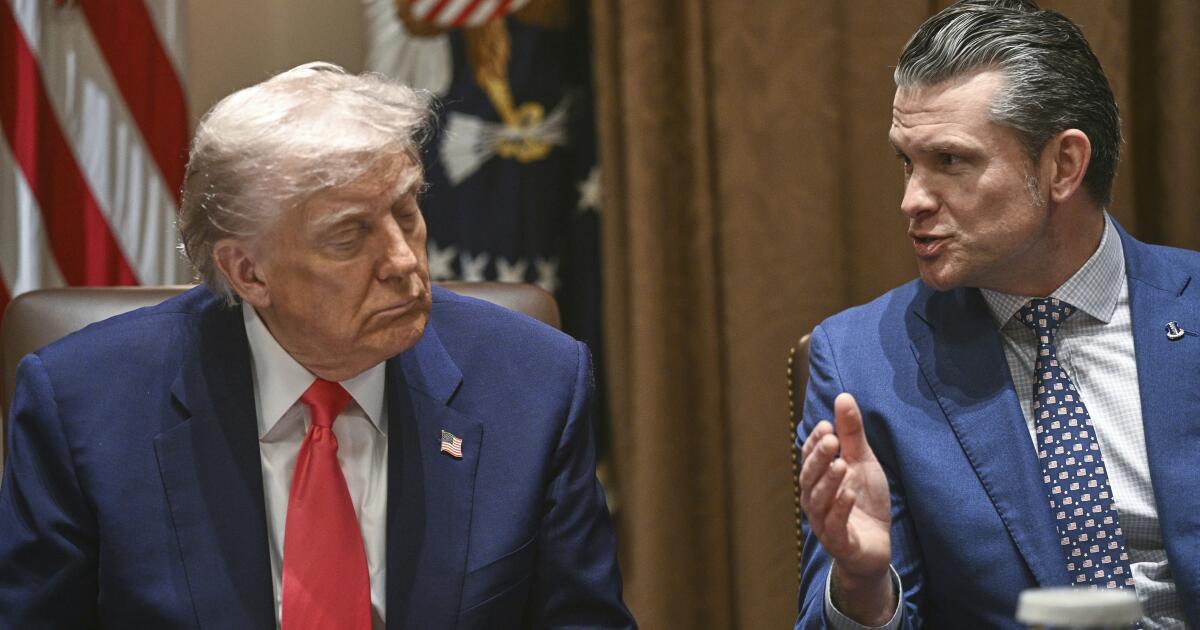

WASHINGTON — The Supreme Court ruled against President Trump on Tuesday and said he did not have legal authority to deploy the National Guard in Chicago to protect federal immigration agents.
Acting on a 6-3 vote, the justices denied Trump’s appeal and upheld orders from a federal district judge and the U.S. 7th Circuit Court of Appeals that said the president had exaggerated the threat and overstepped his authority.
The decision is a major defeat for Trump and his broad claim that he had the power to deploy militia troops in U.S. cities.
In an unsigned order, the court said the Militia Act allows the president to deploy the National Guard only if the regular U.S. armed forces were unable to quell violence.
The law dating to 1903 says the president may call up and deploy the National Guard if he faces the threat of an invasion or a rebellion or is “unable with the regular forces to execute the laws of the United States.”
That phrase turned out to be crucial.
Trump’s lawyers assumed it referred to the police and federal agents. But after taking a close look, the justices concluded it referred to the regular U.S. military, not civilian law enforcement or the National Guard.
“To call the Guard into active federal service under the [Militia Act], the President must be ‘unable’ with the regular military ‘to execute the laws of the United States,’” the court said in Trump vs. Illinois.
That standard will rarely be met, the court added.
“Under the Posse Comitatus Act, the military is prohibited from execut[ing] the laws except in cases and under circumstances expressly authorized by the Constitution or Act of Congress,” the court said. “So before the President can federalize the Guard … he likely must have statutory or constitutional authority to execute the laws with the regular military and must be ‘unable’ with those forces to perform that function.
“At this preliminary stage, the Government has failed to identify a source of authority that would allow the military to execute the laws in Illinois,” the court said.
Although the court was acting on an emergency appeal, its decision is a significant defeat for Trump and is not likely to be reversed on appeal. Often, the court issues one-sentence emergency orders. But in this case, the justices wrote a three-page opinion to spell out the law and limit the president’s authority.
Justice Amy Coney Barrett, who oversees appeals from Illinois, and Chief Justice John G. Roberts Jr. cast the deciding votes. Justice Brett M. Kavanaugh agreed with the outcome, but said he preferred a narrow and more limited ruling.
Conservative Justices Clarence Thomas, Samuel A. Alito Jr. and Neil M. Gorsuch dissented.
Alito, in dissent, said the “court fails to explain why the President’s inherent constitutional authority to protect federal officers and property is not sufficient to justify the use of National Guard members in the relevant area for precisely that purpose.”
California Gov. Gavin Newsom and Atty. Gen. Rob Bonta filed a brief in the Chicago case that warned of the danger of the president using the military in American cities.
“Today, Americans can breathe a huge sigh of relief,” Bonta said Tuesday. “While this is not necessarily the end of the road, it is a significant, deeply gratifying step in the right direction. We plan to ask the lower courts to reach the same result in our cases — and we are hopeful they will do so quickly.”
The U.S. 9th Circuit Court of Appeals had allowed the deployments in Los Angeles and Portland, Ore., after ruling that judges must defer to the president.
But U.S. District Judge Charles Breyer ruled Dec. 10 that the federalized National Guard troops in Los Angeles must be returned to Newsom’s control.
Trump’s lawyers had not claimed in their appeal that the president had the authority to deploy the military for ordinary law enforcement in the city. Instead, they said the Guard troops would be deployed “to protect federal officers and federal property.”
The two sides in the Chicago case, like in Portland, told dramatically different stories about the circumstances leading to Trump’s order.
Democratic officials in Illinois said small groups of protesters objected to the aggressive enforcement tactics used by federal immigration agents. They said police were able to contain the protests, clear the entrances and prevent violence.
By contrast, administration officials described repeated instances of disruption, confrontation and violence in Chicago. They said immigration agents were harassed and blocked from doing their jobs, and they needed the protection the National Guard could supply.
Trump Solicitor Gen. D. John Sauer said the president had the authority to deploy the Guard if agents could not enforce the immigration laws.
“Confronted with intolerable risks of harm to federal agents and coordinated, violent opposition to the enforcement of federal law,” Trump called up the National Guard “to defend federal personnel, property, and functions in the face of ongoing violence,” Sauer told the court in an emergency appeal filed in mid-October.
Illinois state lawyers disputed the administration’s account.
“The evidence shows that federal facilities in Illinois remain open, the individuals who have violated the law by attacking federal authorities have been arrested, and enforcement of immigration law in Illinois has only increased in recent weeks,” state Solicitor Gen. Jane Elinor Notz said in response to the administration’s appeal.
The Constitution gives Congress the power “to provide for calling forth the militia to execute the laws of the union, suppress insurrections and repel invasions.”
But on Oct. 29, the justices asked both sides to explain what the law meant when it referred to the “regular forces.”
Until then, both sides had assumed it referred to federal agents and police, not the standing U.S. armed forces.
A few days before, Georgetown law professor and former Justice Department lawyer Martin Lederman had filed a friend-of-the-court brief asserting that the “regular forces” cited in the 1903 law were the standing U.S. Army.
His brief prompted the court to ask both sides to explain their view of the disputed provision.
Trump’s lawyers stuck to their position. They said the law referred to the “civilian forces that regularly execute the laws,” not the standing army.
If those civilians cannot enforce the law, “there is a strong tradition in this country of favoring the use” of the National Guard, not the standing military, to quell domestic disturbances, they said.
State attorneys for Illinois said the “regular forces” are the “full-time, professional military.” And they said the president could not “even plausibly argue” that the U.S. Guard members were needed to enforce the law in Chicago.