It has been a monumental year for the video game industry, marked by new devices and billion-dollar deals.
Further consolidation occurred within the sector when a consortium led by the Public Investment Fund of Saudi Arabia, alongside Jared Kushner’s Affinity Partners and Silver Lake, announced plans to take Electronic Arts private. The $55 billion deal, which includes $20 billion in debt financing, is the largest leveraged buyout in Wall Street history.
The move could have major implications for EA, according to Omdia analysts. They said the question now is whether the PIF plans to run EA as a “PR project” or “to extract maximum returns” from the company.
French game developer Ubisoft looked to turn its fortunes around this year, although it started 2025 with a second delay to the latest entry in its flagship Assassin’s Creed series, Shadows.
Ubisoft’s shares received a boost in March after announcing the creation of a new gaming subsidiary with Chinese tech giant Tencent called Vantage Studios. The new developer, which will be part-owned by Tencent, will focus on Ubisoft’s key IP — Far Cry, Assassin’s Creed, and Tom Clancy’s Rainbow Six.
Despite Ubisoft’s efforts, shares have lost just over half of their value year to date, and the stock is down over 90% from its 2021 high.
In contrast, Take-Two Interactive‘s shares continued to climb throughout 2025, as anticipation mounted for the next Grand Theft Auto title. It’s been 12 years since the previous edition, GTA 5, was released on Xbox 360 and PS3.
However, with radio silence on GTA 6 for most of the year, fans speculated that an additional delay from the May 26, 2026, release date was on the cards, despite Take-Two CEO Strauss Zelnick telling CNBC in May that he had a “very, very high conviction” the scheduled date would be achievable. In November this year, the game was pushed back to Nov. 19, 2026, with shares in Take-Two tumbling on the news.
The game will launch in the twilight window for Sony’s PlayStation 5 and Microsoft‘s Xbox Series X and S — six years after both consoles were released. As focus shifts to the next generation of consoles, this past generation has seen a change in strategy for both brands.
Console strategies shift
Xbox has moved away from exclusive games, with titles such as Indiana Jones, Forza Horizon, and more releasing on PS5, while PlayStation continues to experiment further with releasing titles on PC.
Take-Two’s Zelnick argued that the shifting strategies will see the video game industry become more open. When asked whether the console will be in business within the next five to 10 years, he said the consoles will still be around, with the devices moving towards PC as “business is moving towards open rather than closed.”
“But if you define console as the property, not the system, then the notion of a very rich game that you engage in for many hours, that you play on a big screen, that’s never going away,” he told CNBC’s Andrew Ross Sorkin in November.
Consoles still have a huge role to play in the market, according to George Jijiashvili, senior principal analyst for Games at Omdia. He told CNBC’s “Squawk Box Europe” that the devices are still “the go-to place for premium games.”
Data from Omdia shows that consoles are the second-largest category when it comes to total consumer spend, with mobile spend contributing 60%, consoles reaching 23%, and PCs hitting 16%.
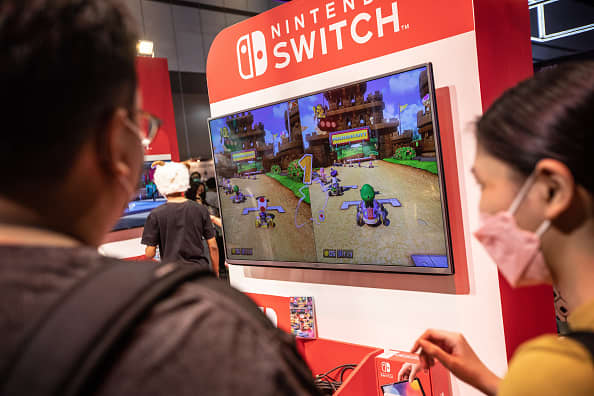
While others mostly abandoned exclusive titles, Nintendo has continued to pursue the strategy, releasing several exclusive titles for its new Switch 2 console – including an open-world reimaging of Mario Kart and a brand-new Donkey Kong game.
This summer, Switch 2 became the fastest-selling console in history, selling 10.36 million units in the first four months of sales.
Not all are convinced by Nintendo’s strategy. Christopher Dring, founder and editor-in-chief of The Game Business, told CNBC’s “Built for Billions” in November that Nintendo faces a challenge in maintaining demand for its systems.
“Unlike PlayStation and Xbox and other platforms, the people buying Nintendo machines are buying it for Nintendo games. What that means is, if they don’t have a game ready, they can not rely on other developers to prop them up.”