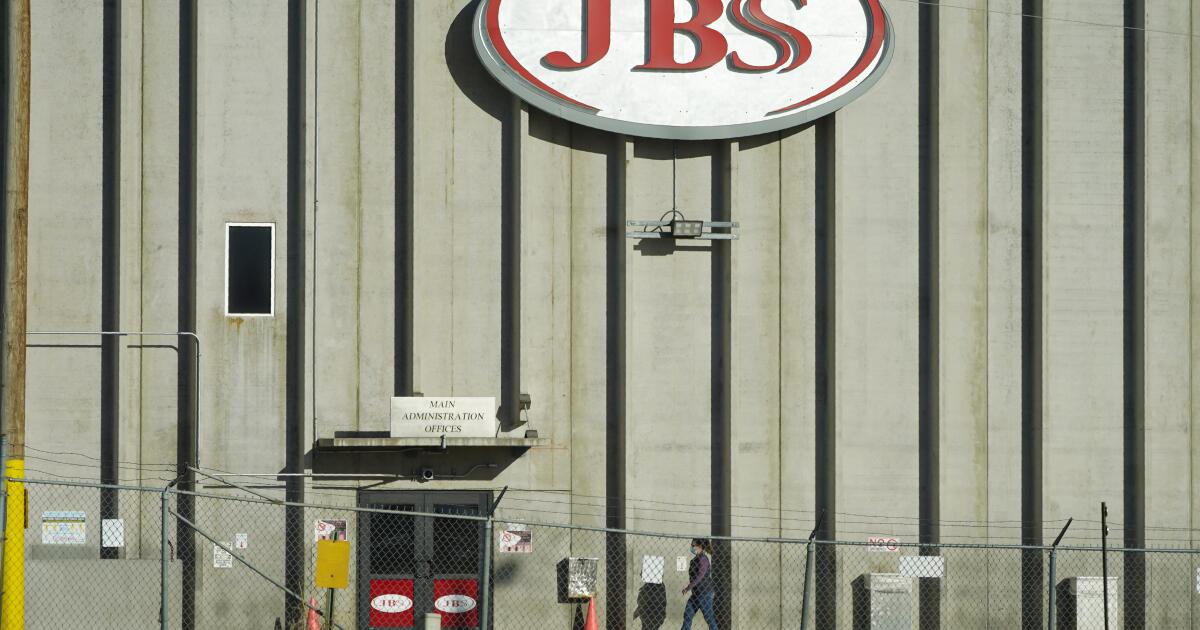

The meat processing company JBS is closing a packing facility in Riverside and will lay off 374 employees, according to a notice from the California Employment Development Department.
The closure comes as a limited cattle supply has led to record-high beef prices this year.
The Riverside facility, operated by JBS subsidiary Swift Beef Co., prepares meat for sale in U.S. grocery stores but does not slaughter animals, JBS spokesperson Nikki Richardson said.
The affected employees will be given opportunities at other JBS plants, including relocation support, Richardson said. Employees who choose not to relocate will be given a 60-day notice period before their employment ends.
The price of beef has soared in recent months as ranchers have cut their herds due to a drought across pastureland and a parasite known as screwworm, which forced a halt to U.S. imports of Mexican cattle. Last month, meat processing giant Tyson Foods closed one if its largest beef-processing facilities in Nebraska.
JBS said production handled at the Riverside plant will be transferred to other company facilities without interrupting customer supply or service.
The transition is expected to be complete by early next year, the company said.
“JBS is committed to supporting impacted team members through this transition,” Richardson said in a statement. “The company remains focused on delivering high-quality products and dependable service while strengthening its operational footprint to meet evolving market demands.”
The Riverside plant closure is part of a broader company strategy to optimize and simplify its operations. Shares of JBS were down less than 1% in midday trading Monday and have remained flat this year, rising about 2% since January.
The company, which has a U.S. headquarters in Greeley, Colo., also has facilities and offices throughout Europe and Australia.
The landscape is shifting in California’s oil industry as well, with Valero Energy Corp. planning to shut down a major refinery in the state by spring 2026.
Last year, Chevron moved its headquarters from San Ramon, Calif., to Houston, citing challenging business regulations in the Golden State. This year, the last factory that turned sugar beets into sugar in California shut down, leading to the elimination of hundreds of jobs in the Imperial Valley.
According to a Chapman University economic forecast released this month, California’s job growth totaled just 2% from the second quarter of 2022 to the second quarter this year, ranking it 48th among all states.
The state lost jobs consecutively from June to September. Also, next year the state is expected to add 62,000 jobs.
California also experienced a net population outflow of more than 1 million residents from 2021 to 2023, with the top five destinations being states with zero or very low state income taxes: Texas, Arizona, Nevada, Idaho and Florida, the report noted.