MEXICO CITY — For centuries she was vilified, her name — Malinche — synonymous with deceit and Indigenous collaboration with Hernán Cortés, the Spanish conquistador for whom she served as interpreter, advisor and mistress.
The writer Octavio Paz, the Mexican Nobel laureate, denounced Malinche as a kind of malevolent Eve whose submission to Cortés forever defiled Mexico’s mixed identity.
In the 1980s, outraged residents of the capital’s Coyoacán district forced the removal of a monument to Malinche, Cortés and their son, Martín, who is often called the first mestizo (mixed-race) Mexican, though others likely preceded him.
She has long commanded a broad fascination, the subject of paintings, novels, films, songs, operas and TV series. The USS Malinche was a 24th century starship on “Star Trek.”
But now Malinche is experiencing a stunning reassessment, her biography recast as an intrepid feminist survival tale, the saga of a young woman who used her wits to prosper in a patriarchal society of swashbuckling and ruthless Spanish conquerors.
“I think it’s fair to say that she is the most important woman in Mexican history,” said Úrsula Camba Ludlow, a Mexican historian who wrote a Malinche biography. “Her decisions helped to shape the very face of Mexico.”

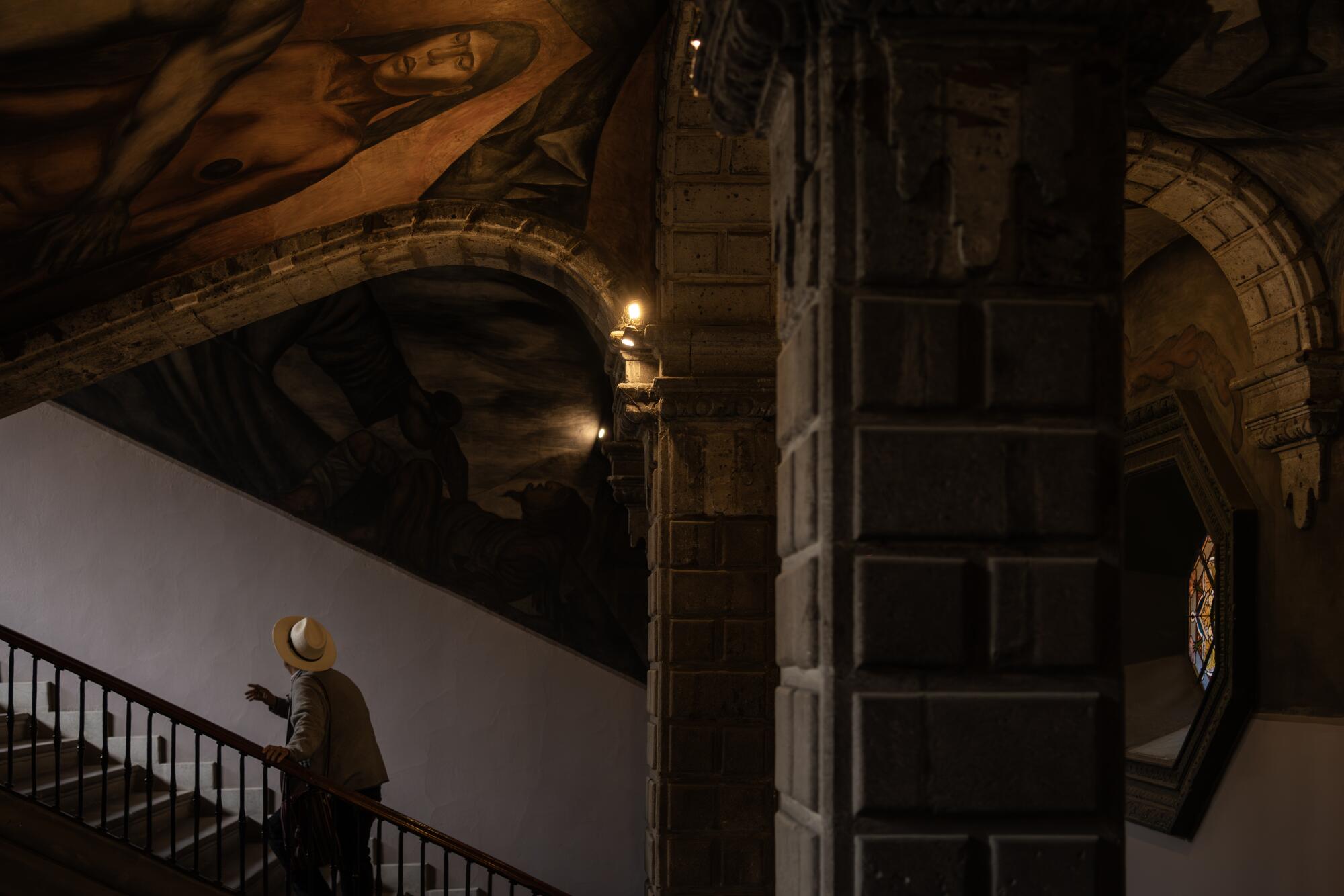
A man ascends the stairs beneath the mural “Cortes y la Malinche” by Jose Clemente Orozco painted on the ceiling above stairs at the Antiguo Colegio de San Ildefonso in Mexico City.
Today, Malinche is lauded by Mexican intellectuals and lawmakers, and her image once again graces a public space in Mexico City.
Just this month, the government installed a bronze of Malinche and five other Indigenous women along the elegant Paseo de la Reforma. It marked the culmination of a rebranding campaign spearheaded by Mexican President Claudia Sheinbaum.
“Why place her figure here after years during which we were taught that she was a symbol of treason?” Sheinbaum asked during a dedication ceremony. “In reality, her life reflects the condition of an Indigenous woman immersed in a world of violence — of invasion and dispossession — that forced her to use her words and her knowledge of languages to survive.”
This time, there were no protests, no one declaring that malinchismo — behavior mirroring that of Malinche — signified a peculiar iteration of Mexican self-hatred.
Further evidence of a paradigm shift: Enthusiastic theatergoers thronging to “Malinche the Musical,” the brainchild of Nacho Cano, a Spanish rock star turned impresario.
“Mexico has two mothers: the Virgin of Guadalupe and Malinche,” Cano told a Mexican interviewer last year, after his spectacle moved from Madrid to Mexico City. “But we have hidden and judged La Malinche without listening to her.”
The extravaganza is a kitschy, almost three-hour tribute to a Malinche who cavorts about the stage in skimpy outfits and falls dreamy-eyed for a benignly depicted Cortés. Scenes on Spanish galleons and Aztec pyramids unfold amid a pulsating beat of rock, pop and flamenco riffs.

The Monumento al Mestizaje depicts Hernan Cortes and La Malinche at Parque Xicotencatl in Mexico City. This bronze sculpture by artist Julian Martinez was unveiled in 1982.
Malinche’s portrayal as a valiant Cortés enabler doesn’t seem to bother audiences, though some decry the work’s pro-Spanish take on the Conquest.
“I think it’s time that we abandon this disrespectful word malinchista to refer to someone as a traitor to Mexico,” said Roberto Pineda, 61, a cafe owner who enjoyed the spectacle. “La Malinche was not a wicked person. On the contrary, I would say that her intelligence places her among the great women in the history of Mexico.”
The reinterpretation of Malinche has been decades in the making. Even as Paz was disparaging her in the 1950s, some Mexican women rose to defend her, but their protestations didn’t resonate in what was, until relatively recently, a macho-dominated society.
The Mexican left was especially hostile toward Malinche, viewing her as a kind of embodiment of imperialism.
Gabino Palomares, a legendary Mexican activist and songwriter, remains best known for “Malinche’s Curse,” a 1970s composition still considered a classic of Latin America’s “New Song” movement.
“Oh, curse of Malinche!” the song concludes. “Disease of the present! When will you leave my land? When will you set my people free?”
Even on the U.S. side of the border, to be called a Malinche was a supreme insult. But starting in the 1960s, some Mexican Americans exploring their identities began to embrace her.

A couple walks past the Casa Colorada in the Coyoacan neighborhood of Mexico City. Some locals link this historical residence to La Malinche and associates with Hernan Cortes following the Spanish conquest, though no definitive historical records confirm the connection.
Malinche “was well known in the Chicana community, and we loved her,” said Inés Hernández-Ávila, professor emerita of Native American Studies at UC Davis. “We claimed her as our mother. “
The Malinche-as-traitor narrative was “being dismantled,” said Hernández-Ávila, daughter of an Indigenous mother and Mexican American father. “We could see that she was being misrepresented and denied her rightful place in history.”
She recalls confronting Palomares in San Francisco after a performance of “Malinche’s Curse.”
“Why are you putting the blame on her?” she asked.”Why is a woman being held responsible for all of this?”
Palomares shrugged and walked away.
Who actually was Malinche? Separating myth from reality is a challenge, but avid researchers have managed to sketch the outlines of a life.
She was born, possibly of noble lineage, in what is now Mexico’s Veracruz state, along the Gulf of Mexico, in approximately 1500. While her birthplace was not in the Aztec domain, it was an area where Nahuatl, the language of the Aztecs, was spoken, along with regional tongues. Her fluency in Nahuatl would soon help shape world history.
Likely between age 8 and 15, she was enslaved by an ethnic Maya faction in present-day Tabasco state, though it is unclear if she was kidnapped or sold. A gifted linguist, she soon mastered Mayan dialects.
In 1519, Cortés landed in Tabasco, where his forces crushed Maya resistance. A defeated cacique offered the Spanish spoils of war: Twenty young women. All were soon baptized. The Spanish didn’t flinch at rape, but they wanted Christian offspring. Among the 20 concubines was the woman who would became known as Malinche. She was christened Marina. (Her birth name is unknown.)
As Cortés eyed the Aztec capital of Tenochtitlán, now Mexico City, Marina participated in a kind of chain translation: She would translate Nahuatl into Mayan to a Spanish castaway who had also been a Maya slave and had learned the language. He, then, would pass the information on to Cortés. But Marina quickly picked up Spanish and emerged as a key advisor to the Spaniards, who were soon referring to her as “Doña Marina,” an honorific of respect.
For Indigenous people, she became Malintzin, a phonetic rendition of her Christian name. For the Spanish, that sounded like Malinche.

A detail view of the mural “Cortés y La Malinche” by José Clemente Orozco.
As the invaders moved north, historians say, Malinche tried to persuade Indigenous groups to surrender — or face ruin.
“When the Spanish would approach a town, she would tell the people: … ‘You can join the Spanish and help bring down the Aztecs. Or you can fight the Spanish,’ ” said Camilla Townsend, a Rutgers University historian who wrote an acclaimed biography of Malinche. “’But they will win in the long run.’ ”
She also was, in a sense, both diplomat and spy. The Spanish credited her with ferreting out plots against them and helping to recruit Indigenous warriors to Cortés’ ranks.
“She saved the Spaniards’ skin time after time,” Camba Ludlow said.
Illustrations from the era show Malinche, serving as translator, as a prominent figure during Cortés’ epochal meeting with Moctezuma on Nov. 8, 1519, on a causeway leading to Tenochtitlán.
After the defeat of the Aztecs in 1521, Malinche married one of Cortés’ captains, Juan Jaramillo, and they had a daughter, María.
The former slave girl became a noblewoman in New Spain, but she didn’t have much time to enjoy her exalted status. By 1529, she had died, possibly succumbing to smallpox, a European scourge.
There is no record of where she was buried. Her remains may lie somewhere beneath the modern-day urban jumble of Mexico City.
For many young Mexicans, the supposed curse of Malinche seems a distant concern, a throwback to another generation, another Mexico. In 2024 the country elected Sheinbaum, its first female president, and there has been growing anger about femicide — the killings of women because of their gender.
With Mexico shedding its legacy of machismo, it’s not so surprising, perhaps, that a statue of Malinche now stands in the capital.

A view of the feet of a new statue of La Malinche, known by her original name Malintzin, along Paseo de la Reforma in Mexico City.
“It’s more than time for the women of Mexico — and for the Indigenous people of Mexico — to be able to shed the burden of this sort of figurative ancestor, La Malinche, who for too long has been depicted as such a horrible person,” Townsend said. “The real woman was brave and intelligent. And she handled the most difficult circumstances as well as it was humanly possible to do.”
Cortés, however, remains a reviled figure. There are no statues of him.
Special correspondent Cecilia Sánchez Vidal contributed to this report.