The saga of a Los Angeles Army veteran who legally immigrated to the United States, was wounded in combat and self-deported to South Korea earlier this year, became a flashpoint during a testy congressional hearing about the Trump administration’s immigration policy.
Homeland Security Secretary Kristi Noem was grilled Thursday on Capitol Hill about military veterans deported during the immigration crackdown launched earlier this year, including in Los Angeles.
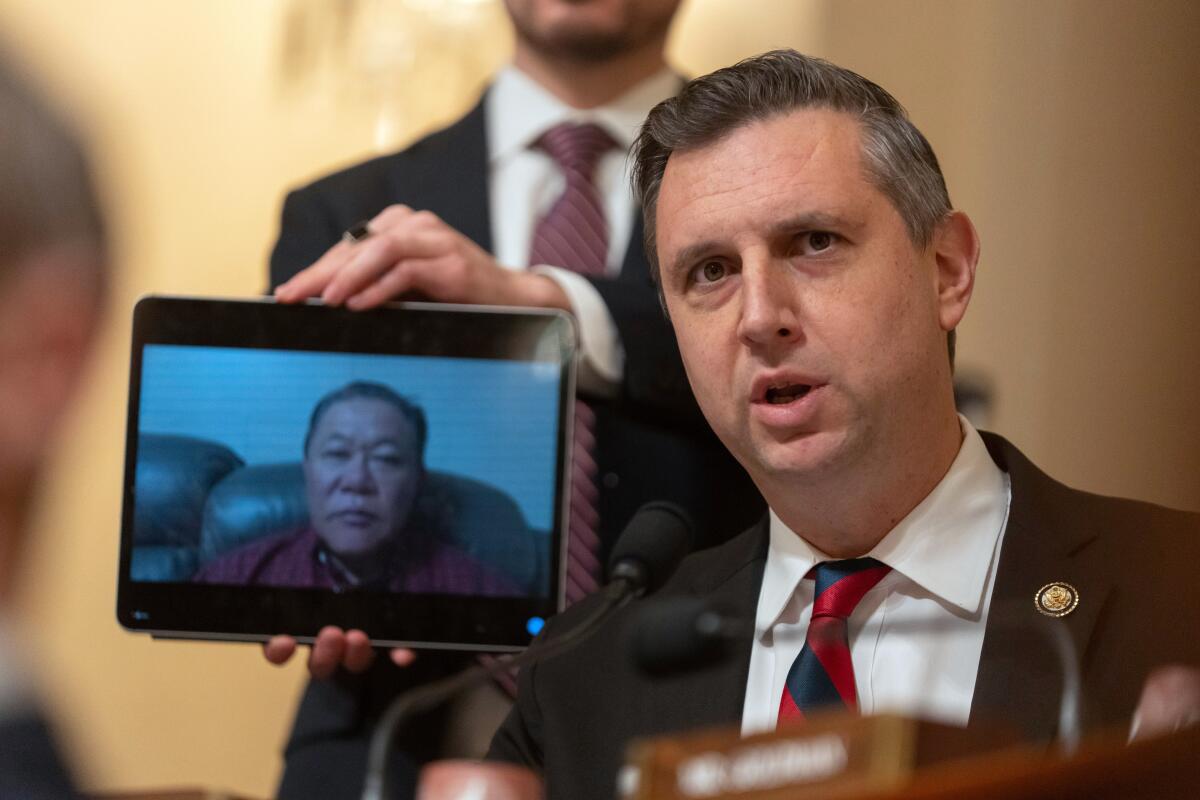
“Sir, we have not deported U.S. citizens or military veterans,” Noem responded when questioned by Rep. Seth Magaziner (D-R.I.).

Rep. Seth Magaziner (D-R.I.) speaks during a hearing of the House Committee on Homeland Security on Thursday. He was joined on a video call by Sae Joon Park, a U.S. military veteran who self-deported to South Korea.
(Mark Schiefelbein / Associated Press)
An aide then held up a tablet showing a Zoom connection with Purple Heart recipient Sae Joon Park in South Korea. The congressman argued that Park had “sacrificed more for this country than most people ever have” and asked Noem if she would investigate Park’s case, given her discretion as a Cabinet member. Noem pledged to “absolutely look at his case.”
Park, reached in Seoul on Thursday night, said he was skeptical that Noem would follow through on her promise, but said that he had “goosebumps” watching the congressional hearing.
“It was amazing. And then I’m getting tons of phone calls from all my friends back home and everywhere else. I’m so very grateful for everything that happened today,” Park, 56, said, noting that friends told him that a clip of his story appeared on ABC’s “Jimmy Kimmel Live!” show Thursday night.
The late-night host featured footage of Park’s moment in the congressional hearing in his opening monologue.
“Is anyone OK with this? Seriously, all kidding aside, we deported a veteran with a Purple Heart?” Kimmel said, adding that Republicans “claim to care so much about veterans, but they don’t at all.”
Park legally immigrated to the United States when he was 7, grew up in Koreatown and the San Fernando Valley, and joined the Army after graduating from Notre Dame High School in Sherman Oaks in 1988.

Sae Joon Park received a Purple Heart while serving in the Army.
(From Sae Joon Park)
The green card holder was deployed to Panama in 1989 as the U.S. tried to depose the nation’s de facto leader, Gen. Manuel Noriega. Park was shot twice and honorably discharged. Suffering post-traumatic stress disorder, he self-medicated with illicit drugs, went to prison after jumping bail on drug possession charges, became sober and raised two children in Hawaii.
Earlier this year, when Park checked in for his annual meeting with federal officials to verify his sobriety and employment, he was given the option of being immediately detained and deported, or wearing an ankle monitor for three weeks as he got his affairs in order before leaving the country for a decade.
At the time, Department of Homeland Security Assistant Secretary Tricia McLaughlin said Park had an “extensive criminal history” and had been given a final removal order, with the option to self-deport.
Park chose to leave the country voluntarily. He initially struggled to acclimate in a nation he hasn’t lived in since he was a child, but said Thursday night that his mental state — and his Korean-language skills — have improved.
“It hasn’t been easy. Of course, I miss home like crazy,” he said. “I’m doing the best I can. I’m usually a very positive person, so I feel like everything happens for a reason, and I’m just trying to hang in there until hopefully I make it back home.”
Among Park’s top concerns when he left the United States in June was that his mother, who is 86 and struggling with dementia, would die while he couldn’t return to the county. But her lack of awareness about his situation has been somewhat of a strange blessing, Park said.
“She really doesn’t know I’m even here. So every time I talk to her, she’s like, ‘Oh, where are you?’ And I tell her, and she’s like, ‘Oh, when are you coming home? Oh, why are you there?’” Park said. “In a weird way, it’s kind of good because she doesn’t have to worry about me all the time. But at the same time, I would love to be next to her while she’s going through this.”