Heated exchanges between Iran and the U.S. continued unabated over the weekend, while Iranian missiles rained down on Gulf states and Israel attacked critical infrastructure in Tehran.
U.S. President Donald Trump warned, “Today Iran will be hit very hard!” and Israel’s Benjamin Netanyahu vowed that “many surprises” lay ahead for the next phase of the week-old conflict. A top Iranian official responded: “We do not welcome the war, but aggressors should be punished.”
Airstrikes on Iran continued on Saturday, one week after the U.S. and Israel launched their joint campaign to rid Tehran of its nuclear and ballistic missile capabilities and push for regime change.
U.S. forces struck more than 3,000 targets in its first week of Trump’s “Operation Epic Fury,” the U.S. Central Command said in an X post. The Israel Defense Forces said in a Saturday post on X that it has completed “another wave of attacks in Tehran,” with its Air Force fighter jets having launched roughly 230 munitions toward several military sites of the regime.
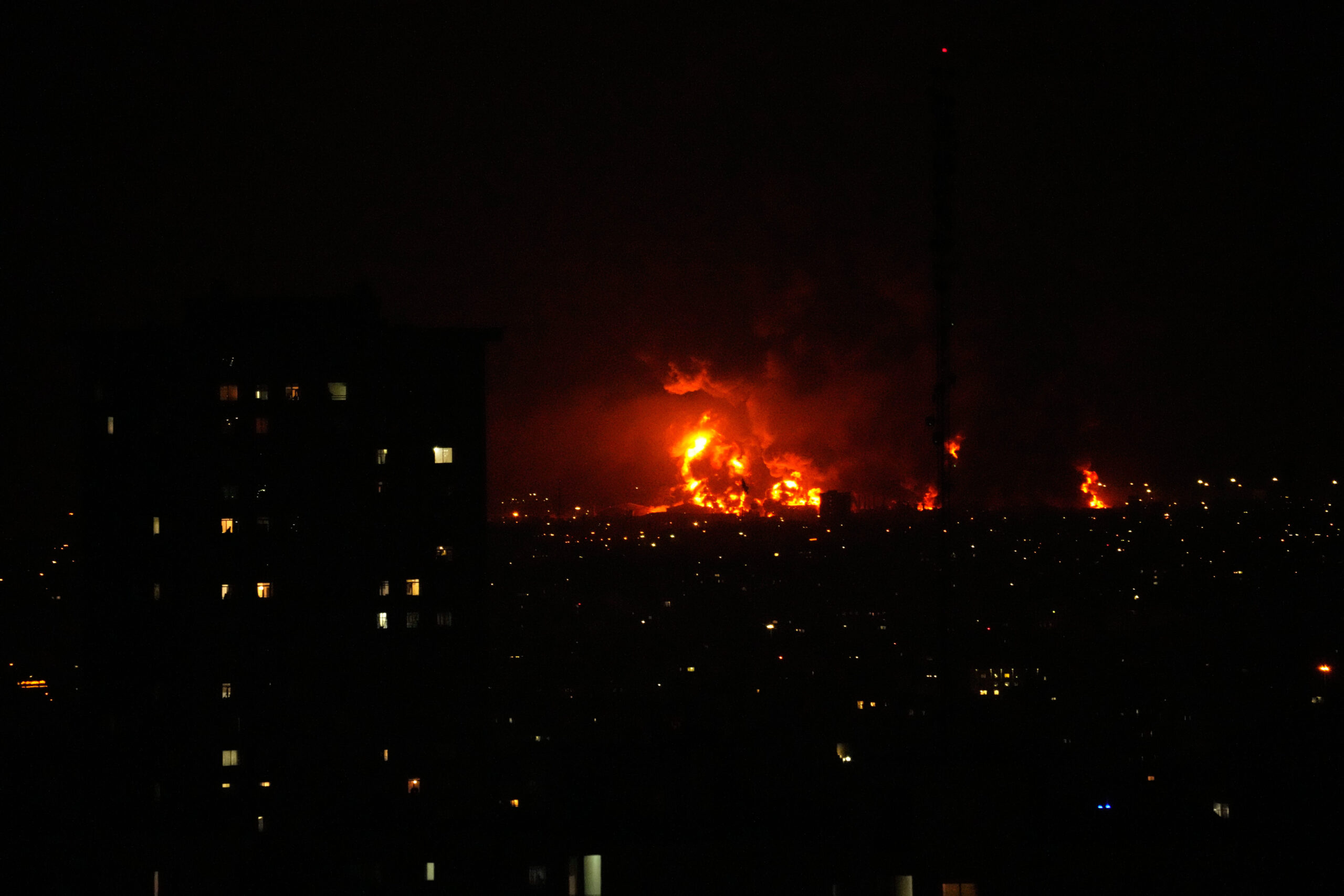

One of the attacks struck a southern Tehran oil facility, Iranian state media confirmed. It appeared to be the first time a civil industrial facility has been targeted in the war, according to the Associated Press. State media blamed “an attack from the U.S. and the Zionist regime” at the facility that supplies the capital and neighboring provinces in the north.
Meanwhile, Tehran’s energy-rich neighbors in the Gulf said they intercepted more Iranian missiles and drones headed for their airspace.
Earlier Saturday, Iran said it struck a U.S. air base in the United Arab Emirates, shortly after Iranian President Masoud Pezeshkian said his country would stop attacking Gulf countries. Iran’s Tasnim News agency said the Islamic Revolutionary Guard Corps’ navy drone unit attacked the Al Dhafra air base south of Abu Dhabi, capital of the United Arab Emirates.
The UAE’s Ministry of Defence said in a post on X that it detected 121 unmanned aerial vehicles on Saturday and intercepted 119 of them, while two fell within the UAE’s territory. The UAE’s Ministry of Foreign Affairs did not immediately respond to a CNBC request for comment.
Ali Larijani, a top Iranian security chief, said that “we do not welcome the war, but aggressors should be punished.” He also called for unity among Iranian officials.
Larijani’s statement follows an apologetic one by Pezeshkian on Saturday, in which he said his country does not intend to attack others.
“I apologize to the neighboring countries,” Pezeshkian said. “We do not intend to invade other countries. Let us set aside all the disagreements, concerns, and resentments we have toward each other. Today, let us defend our own soil to bring Iran out of this crisis with dignity.”
Addressing demands for surrender, Pezeshkian, via Iran’s national news agency’s Telegram social media channel on Saturday, said the U.S. can “take their dreams to the grave; we will not surrender unconditionally.” His comments came after Trump on Friday demanded Iran’s “unconditional surrender.”
Trump followed up his demands early Saturday by taunting Iran with a post on his Truth Social account: “Iran, which is being beat to HELL, has apologized and surrendered to its Middle East neighbors, and promised that it will not shoot at them anymore. Today Iran will be hit very hard!”
Pezeshkian’s apology also prompted pushback from hardliners in Iran’s Revolutionary Guards and clerical elite. In one of the most open criticisms of Pezeshkian, hardline cleric and lawmaker Hamid Rasai addressed the president on social media, saying: “Your stance was unprofessional, weak and unacceptable.”
Gulf region under threat
States in the Gulf are launching air defenses to fend off Iranian attacks, many of which are in the form of one-way drones such as its low-cost Shaheds.
Iran has targeted several radar and air defenses in the Middle East — in Qatar, the U.A.E., Jordan, Bahrain, Kuwait and Saudi Arabia — in retaliation against U.S. and Israeli attacks, The Wall Street Journal reported, citing U.S. officials, military analysts and commercially available satellite images.
Saudi Arabia’s Ministry of Defense has said it intercepted and destroyed two ballistic missiles launched towards Prince Sultan Air Base, an active United States Air Force Air Expeditionary Base in Saudi Arabia. The country intercepted nine of 10 Iranian drones launched at it on Friday.
Saudi Arabia has told Iranian officials that while it favors a diplomatic settlement to Iran’s conflict with the U.S., continued attacks on the kingdom and its energy sector could push Riyadh to respond in kind, sources told Reuters. The message was conveyed before Pezeshkian made his apology, Reuters reported.
Elsewhere, the UAE’s biggest city, Dubai, issued an alert urging residents to seek immediate shelter in secure buildings and stay away from windows, doors and open areas.
In Dubai, several blasts were heard Saturday morning and the government said it had activated air defenses. Passengers waiting for flights at Dubai International Airport were ushered into train tunnels.
The fighting has killed at least 1,230 people in Iran, more than 290 in Lebanon and 11 in Israel, according to officials in those countries. Six U.S. troops have been killed.
Strait of Hormuz transit slows to trickle
Traffic is nearly nonexistent in the Straight of Hormuz, meanwhile, as oil tankers remain fearful that their vessels will be caught in the war’s crossfire.
Data from the Maritime Information Center revealed that the number of vessels transiting through the Strait each day has fallen to the single digits. Only four commercial transits were confirmed in the past 24 hours, the data showed.
Iran’s Larijani said that while Iran has not closed down the Strait of Hormuz, the Strait is effectively closed because of the war.
Kuwait, the fifth-largest oil producer in OPEC, said it is cutting oil production due to “Iranian threats against safe passage of ships through the Strait of Hormuz.”
Escalating war disruptions to global fuel supplies have sent the price of U.S. crude oil skyrocketing, recording its biggest weekly gain in futures trading history. U.S. West Texas Intermediate crude soared 35.63% for the biggest weekly gain in the history of the futures contract dating back to 1983. Global benchmark Brent crude jumped about 28% for its biggest weekly gain since April 2020.
The price of U.S. crude has risen nearly 60% since the start of this year.
Call to name new supreme leader
Two influential Iranian clerics called for the swift selection of a new supreme leader, Iranian state media reported.
One of the clerics, Naser Makarem Shirazi, a grand ayatollah who commands a broad following for his religious rulings, said an appointment was needed swiftly to “help better organize the country’s affairs,” state media reported.
The calls suggest that at least some in the clerical establishment are uncomfortable with leaving a three-man council in charge — even temporarily under constitutional rules — after the killing of Supreme Leader Ayatollah Ali Khamenei.
Trump has argued the U.S. should have a role in choosing the new leader, a demand Iran has rejected.
— CNBC’s Emma Graham, Spencer Kimball, Terri Cullen, Reuters and the Associated Press contributed reporting